Disagreeing with Books: Writer Responsibility and Reader Accountability

“There is no such thing as a moral book or an immoral book. Books are well written or badly written. That is all.” –Oscar Wilde

By far, the blog of mine that has gotten the largest, most passionate and intelligent reactions has been “Why I’m Tired of People Ragging on Twilight.” Comments ranged: gleeful agreement and support of my guts in approaching such a volatile topic, carefully-worded debate, and emotionally-charged (dare I call them?) accusations. I disagreed with many comments, but I could see the logic and thought behind all of them. If you haven’t had a chance to check out the comments on that post, I think they’re well worth a read.

But one thing, the main thing, that I kept coming back to as I read these comments was the concept of censorship and author responsibility. No matter what someone’s thoughts were on the messages in Twilight, the end result was the same: holding Stephenie Meyer accountable for sending said messages.

Admittedly, there is a difference between censoring and judging... for most people.

I saw a contradiction there. Since I follow and am followed primarily by other writers on Twitter (who are unfailingly also readers), I tweeted the following:

@AnnieNeugebauer When you write a character, do you have them make the choices that “send the right message” or that they would most realistically make? Or do you only write characters who make choices that teach morals? And does that answer change if you write YA instead of adult?

All of the writers who answered chose “realistic characters” over “creating morals,” even for young adult books. And yet… so many people complain when they disagree with the message of a book.

The only explanation I could think of was that there is a disconnect between reading and writing. As writers, we all have different goals. Some people want to uplift and enlarge the lives of their readers. Some want to show life as it truly is. Some just want to entertain. And as readers, our wants vary too. We want to learn, be entertained, be challenged, and see ourselves deeply reflected in characters we love. Somewhere between the two, our expectations must shift.

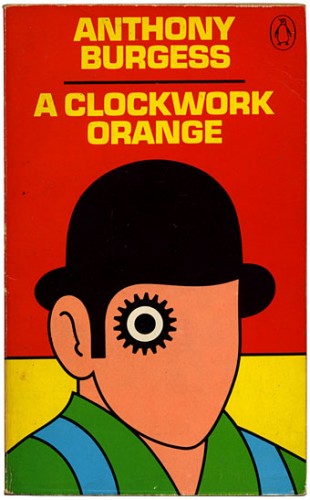
So where’s that line? What changes between a writer and a reader? What are the expectations of both, and more importantly, who is ultimately responsible? And does the answer vary depending on the level of morality being challenged by a book? What about the type of morality? Wuthering Heights is often accused of romanticizing destructive love. A Clockwork Orange purportedly caused copycat crimes of rape and beatings. Lolita looks at the world through the eyes of a pedophile protagonist. And American Psycho was so controversial that Bret Easton Ellis received death threats over it (ironic, no?).

Droogs: product of literary genius, encouragement for young people to rape and murder, or source of awesome Halloween costumes?

How many people have these books negatively influenced? And would those people have made similar choices eventually even if they had never read the books? Of course, no one can know these answers.

Personally, I will never agree that writers are responsible for readers’ beliefs. That’s just how I feel. I am 100% against censorship. Now, that doesn’t mean I like the messages in all books. Obviously, I don’t. There are some themes in the Twilight series that I strongly disagree with. Just because I don’t believe the books should be censored or that Meyer should be held responsible for readers’ choices doesn’t mean it doesn’t bother me that so many young women are possibly being influenced by her messages. It does. It really does.

And my answer thus far leans toward guardian responsibility: parents of young teens should talk to their children about the messages in the books. But what about kids who don’t have such involved, responsible parents? I don’t know. I’m really asking. It’s not an easy question to answer. Should all people be censored because some people might be negatively affected by something? I don’t think so, but I do feel sad for those young women (and men).

To equate (and perhaps conflate) one morally controversial topic with another, it’s sort of like the old saying, “Guns don’t kill people; people kill people.” To which many have quite snarkily replied… but the guns sure make it easier. Ever tried pointing a finger-gun at someone and saying bang? Not quite the same effect. And yet the right to bear arms is one of Americans’ fundamental (though controversial) freedoms – one that I strongly agree with. So there’s a conundrum. I dislike guns, but believe in people’s right to own and use them.

Yeah... crazy mother fuckers with guns.

Twilight doesn’t cause young women to make harmful choices. I have to believe that. It is one of my strongest principles that young people deserve respect. Respect comes with responsibility. And I believe all people, even impressionable young people, must take responsibility for their own morality. You can’t blame your bad choices on a book.

But maybe I believe this because I am a writer, and I sympathize with authors who stand accused. What’s more, I’m a horror writer. I write about some really, really bad people. Perhaps one could argue that I’m simply protecting myself from potential future reader accusations. I want to be able to write about evil, deeply flawed characters, and poor choices without the burden of guilt riding me like the weight of the world. I think, to some degree, we all choose our morals based on what allows us to live the life we want to live. Maybe I’m just in denial.

What do you think? And do your opinions shift when you answer the question as a reader and as a writer? What about as a parent? Where, for you, does author responsibility end and reader accountability begin?

Posted in Books | Tagged , , | 36 Comments

The Adventures of Squirmy

I thought you guys might like a laugh to get your week started. Here’s a poem of mine that won the National Federation of State Poetry Societies sonnet contest in 2010. It was first published in their prize anthology Encore.

The Adventures of Squirmy

My brother had a frog with four webbed feet—
a gift. My mother wouldn’t touch the thing,
but driven by her need to keep things neat,
set out to clean his filthy tank, one spring.
So Squirmy got a temporary home
of glass; no lid did grace its shorter top,
thus Squirmy sensed his chance to jump and roam
about on new dry land; so out he popped,
slipped down the kitchen sink with one knee-jerk.
My mother, scared of frogs…well, lost control
and thought she had to call my dad at work,
so when he heard her say “disposal hole,”
he figured Squirmy’d be already gone
and all he knew to say was, “Turn it on.”

Annie Neugebauer
© 2010, All rights reserved.

*Yes, it is a true story. And no, Mom did not turn it on. Squirmy lived for many more adventures and an incredible 10 years.

Posted in My Works | Tagged , | 9 Comments

Physical Books: Reading, Sniffing, and Torturing

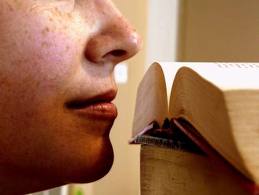
Mmmm… doesn’t that smell good?

I have a piece of flash fiction that was just published today in the December issue of The Washington Pastime. Wee! I love it, have always loved it, and am very happy that it found such a lovely new home. My story is called, “The Book Sniffers,” and can be found on lucky page thirteen. *thumbs up*

As you might gather from that title, I enjoy sniffing books. A lot. In fact, I occasionally go to libraries and used book stores just to browse the aisles and sniff. And I’m not the only one. Turns out there’s a chemical reason for that delicious old book odor:

“Lignin, the stuff that prevents all trees from adopting the weeping habit, is a polymer made up of units that are closely related to vanillin. When made into paper and stored for years, it breaks down and smells good. Which is how divine providence has arranged for secondhand bookstores to smell like good quality vanilla absolute, subliminally stoking a hunger for knowledge in all of us.” –from Luca Turin and Tania Sanchez’s Perfumes: the guide

So I’m not *totally* crazy. (Yeah, okay – I am.)

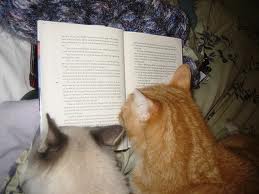
Even teh kittehs want in on teh actshun.

I like to think of physical books as candles: what’s the point of having them if you’re afraid to use them? Some people will buy candles that are so pretty that they never burn them. I’ve never really understood that. To me, a candle (like a book) is a functional thing. Pretty? Sure… while you’re using it. Key word = “using.” Neither are meant to live on a shrine.

Uh-oh. I’ll have to break the glass to sniff that bad boy.

My dad used to hate it when people broke the spines on his books. He didn’t like that white line that went through the title. But how are you going to read comfortably if you’re only holding your book open at a 90 degree angle? I tried to be careful when I borrowed books from him, but when I bought my own, you better believe the first thing I did was crack that sucker open. I love the sound of a book spine breaking for the first time. Makes me feel like an officer of the Spanish Inquisition.

I love torturing books.

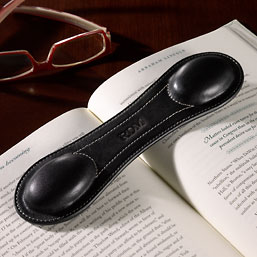
Check out this book weight. I use it almost every single day of my life. If someone found this in my bedside table, unexplained, they would surely think it was… well… something saucy.

Drop your pants and spread ‘em, book.

And that’s not all. I shamelessly dog-ear corners if I lose my bookmark. I clasp pages open with clothespins at the gym. I splatter soup on pages while using my bookstand. I take off book jackets completely. My cats chew the corners of hardbacks. I tote little paperbacks in my purse. I mark up the margins like I’m still in college. I show my books no mercy, and they love it.

Please, Miss, can I have some more?

Because honestly, what’s the point of having a book if you’re afraid to use it? To really get in there and – forgive me – abuse it with glee? With the rise of e-readers, physical books have become even more of a treasure to me. I don’t have anything against ebooks; my husband has an iPad and I’ve read a couple of books on there and liked it just fine. But there are things a physical book can give you that a screen just can’t. The main thing being an experience.

This screen just smells like cogs and finger smudges.

[Side note. Did you read about Ray Bradbury releasing Farenheit 451 as an ebook? Ironic. Almost as ironic as “The Book Sniffers” coming out through digital publishing.]

No doubt times are a-changin’. And even as a physical book fanatic, I think that’s okay. I, for one, will still teach my kids and grandkids the love of a good, hardcover book, just as my mother taught me. And come to think of it, my Gammy always said an unburned candle is tacky, tacky, tacky. So crack a spine, torture a book, read it, for God’s sake… and really get in there and sniff.

What do you think? I’d love to hear your opinions and stories, book lovers! What’s your favorite book memory? Do you value physical books? Will you always? How do you treat them, and why?

Posted in Books | Tagged , , | 12 Comments

Why I’m Tired of People Ragging on Twilight

I’m hesitant to even write this blog. For one thing, defending Twilight makes me seem like a fan, and I’m not really. I don’t hate it or anything – I’ve read all four books and enjoyed them for what they were – but I’m certainly not going to the movies on opening night or convincing my husband to replace my wedding ring with the one designed based on Bella Swan’s:
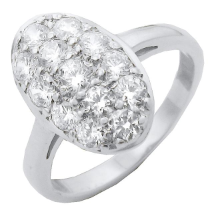
Not that there’s anything “wrong” with wanting a fictional character’s ring in your real life. That’s not crazy at all. Or something.

And I’ll go ahead and make it clear now that I am not trying to convince you to like Twilight. I really, really do not care if you like it or not. But I feel the need to address the type and level of Twilight hate that’s been going around… you know… all of Earth. Because underneath the seemingly hostile and somewhat amusing slams and pot-shots taken at the books, there are some actual important issues at play.

Bandwagons

Here’s the thing: I hate bullies. I hate bandwagons. And I really, really hate bullies who jump on bandwagons. I have seen people on Facebook announce that if they see any mentions of Twilight in their newsfeed they are unfriending the person who posted it. I mean, I know it’s ‘like really cool’ to not like what’s popular and stuff (Hey, if it doesn’t say “indie” on the back cover it’s a sell-out, right?), but that seems a little extreme, doesn’t it?

And the real kicker is that most of the people I hear dissing the Twilight series almost certainly haven’t even read any of the books. They’re just jumping on bandwagons. Twilight is trendy, and thus it is trendy to slam it. Lazy much? If you’re going to hate on something so hard, at least do your research. And the flip-side? If you do your research, and still hate it that much, why do you keep talking about it?

Writing Quality

The primary complaint I hear from writers who diss the books is that the quality of Stephenie Meyer’s writing is poor. And my answer to that is… so what?

For one thing, quality is subjective. Plot can be just as important as character, and different writing styles strive to achieve different things. But I’m not going to try to argue that Stephenie Meyer’s writing is particularly good. I don’t think it is.

But there are hundreds of poorly written, incredibly popular books published every year and that’s never stopped the general public from liking them. Aspiring authors’ agony be damned: crap gets published and people love it. Deal with it.

Content

The next complaint I hear is about the message of the books. I’ve already addressed the ignorant, ultra-conservative parents who think these books are evil. But on the other spectrum are the ultra-liberal parents who think these books send an unrealistic, overly romantic and thus harmful message to young girls, much like Cinderella.

“Stephenie Meyer has come and she’s taken the genre that I sort of pioneered. Her original audience was 11- and 12-year-olds, so she – very rightly – sanitized the genre. She took out a lot of the sex and violence, especially for the first book…I ask people, Why has this really captured you? What I heard from all ages is that it was very romantic that he was willing to wait for her and that there was no sex. They like the idea that [Bella] was like the fairy princess and [Edward] is the handsome prince that rides in and saves her. The fact that women are so attracted to that idea – that they want to wait for Prince Charming rather than taking control of their own life – I find that frightening.” — Laurell K. Hamilton, Entertainment Weekly

Now you guys know I adore Laurell K. Hamilton. And I adore her fierce independence and constant striving for sexual equality. But I also adore cheesy, sleazy romance novels with lots of sex and unrealistic-hero expectations, and if Twilight is harmful, then those are ten times harmful. But I would argue that they aren’t. It’s fiction. It is the epitome of fantasy fulfillment. Emphasis on fantasy. It’s fulfillment through fiction because we know that real life won’t cut it.

I didn’t watch Cinderella thinking that I would marry a prince (good post on that here), and I didn’t read Twilight thinking that my significant other would ever be as over-the-top obsessed and dedicated as I fantasized he would be. Who doesn’t want to be intensely desired? The books deliver that. It’s just for fun. It’s not real. Give readers a little credit; they know that. And if they don’t? That responsibility goes to their parents, not the author. I will never agree that writers are responsible for readers’ beliefs.
Gender politics

And here’s what’s really bothering me. To me, as an adult woman who seems to be one of the few people who’s not screaming and rioting either for or against “Team Edward” or “Team Jacob” (Okay, okay: I’m totally team Edward. Your abs mean *almost* nothing to me, Jacob.), this is all because The Twlight Saga is a girl thing. Yes, that’s right, I said it. It is just as mainstream-cool-and-thus-really-lame as Harry Potter and The Hunger Games (two other crazy-popular young adult series), but people don’t rag on them because those series are geared toward boys.

Don’t argue yet. Read this:

“People are attracted by the stories, by the pace, and in the case of Stephenie Meyer, it’s very clear that she’s writing to a whole generation of girls and opening up kind of a safe joining of love and sex in those books. It’s exciting and it’s thrilling and it’s not particularly threatening because it’s not overtly sexual.” – Stephen King, USA Weekend

I can’t help but think of gender politics. Now, in literature as in most fields, the market is dominated by men. There are plenty of female voices, but the male voices seem to be louder and more weighty. Books focusing on “boyhood,” like Something Wicked This Way Comes, The Yearling, and Robinson Crusoe are generally taken more seriously – as far as literary merit – than books focusing on “girlhood,” like Little Women, Sarah Plain and Tall, and Little House on the Prairie. I would argue that this is only because our society still tells us that men are more valuable and more serious than women.

And the very implication that Twilight is for girls while Hunger Games is for boys can be insulting, suggestive, and argued. But I don’t have time for all of that. I’m not saying it’s right; I’m just saying it is. Twilight is a “girl book” because it focuses on romance. (Teen boys tend to mature at a later age than teen girls, so they escape a lot of this discussion.)

Love between adults is, arguably, the single most important subject in all of literature throughout all of history, perhaps rivaled only by death and religion. Love is considered noble, vital, and well-worthy of literary pursuit.

Teenagers forming romantic relationships with each other is a necessary step in the human life cycle to find a partner. And yet… teen romances are slammed by critics, considered “flighty” and “trashy” and “focusing on the wrong values.” Why? I’m really asking. Why is it noble for adults and frivolous for teens? And furthermore, why are teenage girls learning the ropes of romantic and sexual relationships considered shallow? I believe that people become derisive about it simply because it makes them uncomfortable.

Teenaged females are in between girls and women, and the idea of them being sexual or even romantic makes adults squirm. That is not a good enough reason to mock teenaged girls, their genre interests, or these books.

Comparisons
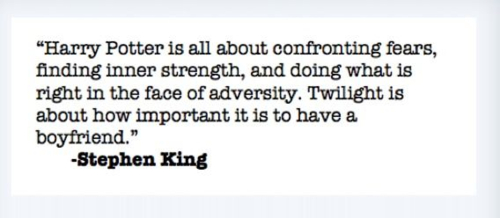
*This quote, in particular, is pissing me off. Not only for its implications when it comes to gender politics, as I mentioned above, but also for one very important reason that I keep seeing crop up in the Twilight discussions:

It is not a competition. One excessively popular book need not be pitted against another excessively popular book. I see it EVERYWHERE. Twilight sucks because… Harry Potter is better? What good does that comparison do, exactly? Makes people feel like they have to choose one to love and one to hate. Believe it or not, it is entirely possible to love both, hate both, or feel relatively ambivalent about both.

I would really, really love to stop seeing this quotation passed around like it’s a Bible verse.

And one more thing…

Just for the record. Making fun of “sparkly” vampires is easy, because the word in and of itself is sort of silly and vaguely flamboyant, so having a creature that was once thought of only as “scary” be “sparkly” is a pretty easy target.

But let’s be honest; Stephenie Meyer was not the one to take vampires from scary to sexy. Chelsea Quinn Yarbro, Anne Rice, and Laurell K. Hamilton did that for her. Vampires can still be scary, but they can also now be sexy. It’s been done; it can’t be undone. So get over it.

The truth is that vampires glittering in the sun is actually a really cool, original concept. In Stephenie Meyer’s world, humans don’t know vampires exist. But making them glitter allowed her to change the rules: her vamps were not immune to the sun, but rather wise to evade it to avoid risk of exposure to humans. And since Ms. Meyer was simply embracing the preexisting idea of the romantic vampire, I also think it’s a nice finishing touch on her version of the creature. If a human had skin that glittered and I was in love with him, I’d think it was pretty neat too. So eff off, haters. Let them vamps get their glitter on.


What do you think? Am I right? Are there gender politics involved here? And will there ever be something teen girls love that isn’t mocked by the rest of the population (see: Hannah Montana, Miley Cyrus, Justin Beiber…)? Or is it just too easy/fun to slam Twilight? And most importantly, why all the hate, haters? I know you’ve got Breaking Dawn tucked under your nightstand. 😉

*I haven’t been able to verify this quotation. The typed one is from an interview he did with USA Weekend, but the one that’s been made into an image and infecting the interwebs could be made up or misattributed. Anyone know for sure?
Posted in Books | Tagged , , , | 55 Comments

Lessons from a Writing Retreat

Hi guys! I just got home from a self-constructed writing retreat with two of my best writing buddies. Before I get back into the normal of groove of things today, I thought I would share with you all some of the things I learned on my little trip.

And if you haven’t yet, writers especially, please go read my guest blog at Writer Unboxed! Okay, here we go…

Lesson #1: My “ergonomic” keyboard is useless if I don’t use it right.

If you work at a computer, take a moment to look at your desk. Now think about your body. What hurts? My bet: neck, shoulders, wrists, and forearms, plus possibly back, knees, and even ankles.

I thought I was doing pretty good. I mean, I have an ergonomic keyboard, a foot rest, and my screen raised up on a stand. But I was still having pain.

Three day retreat, with five times my normal daily word count, and I was almost pain free. The difference? The table I was using and my positioning on that table. I had my laptop propped up on a binder and pushed back about two feet away from the edge. That way, my forearms were resting on the desk. That this could make such a difference had never even occurred to me.

My lesson: Experiment until I find what feels the best.

Lesson # 2: I have been setting my daily word count goal way too low.

Everyone has different word count goals because everyone has different circumstances in which they write. Some people have three day-jobs and can only write on the weekends. Others, like me, work at home all day writing. So this isn’t about my specific numbers; those are irrelevant. It’s about goals.

When I’m not working on a first draft of a novel (which makes my word count go up drastically because I like to pound them out), my daily word count goal is 1,000 words. That can include poetry, short stories, or whatever (blogs don’t count), but I try to hit that minimum five days a week.

At this retreat, I did 5,000 words a day. That’s FIVE TIMES my daily goal. And it wasn’t even difficult! What the spelunking?! I know retreats are different than real life. I mean, there really isn’t anything to do but write, so it’s easy to have a higher output, but still. Adjust that number for paying bills, cleaning up cat vomit, and buying groceries, and I could still easily double my previous goal.

My lesson: I had gotten comfortable with where I was and never moved up. I was being too easy on myself.

Lesson # 3: Brains need food too.

So crazy output is great, as long as you don’t feel like a steaming pile of zombie brain at the end of the day. At the end of my first 5,000 word day, I was so tired I couldn’t even think. As I lied in bed wondering how just sitting at a desk and thinking could be so tiring, it hit me: I was doing five times my normal output and eating less food.

I mean, all I was doing was typing. Who needs a big lunch when they’re sitting still all day? But the thing is that even brains need fuel. The next day I did the same output, but was conscious to have small snacks every couple of hours. I was still tired at the end of the day, but I didn’t feel like a brain zombie.

My lesson: higher productivity requires higher energy input.

Lesson #4: The world doesn’t end when you don’t have internet.

Really. It was still there when I got back.

(I know, I was kind of surprised too.)

My lesson: It’s okay to unplug.

Lesson #5: My friends are the best.

I mean, look at them! They speak of movies, boobies, books, and awesomesauce.

This is Addley. She has excessively loud sneezes.

 This is Febe. She helps me rate Addley’s excessively loud sneezes on a scale of 1 to 10.

My lesson: writing with friends is only about a thousand times better than writing alone. Bonus: free brainstorming sessions!

Lesson #6: Beautiful views are not so much seen as felt.

You must feel it here *taps heart*, not here *taps head*.

We were lucky enough to have a gorgeous, brand new vacation house to go to for free. (Thank you to Addley’s Aunt Susan!) There was a whole wall of windows overlooking a lovely view of a part of the Colorado River. I looked at it, of course. I stared at it. I went out on the deck and mused over it. And then I got to work.

Did I need the view to write? No. When I was actually actively writing, I didn’t even glance at the view. But the strange thing – the really magical thing that makes retreats totally worth it – is that I could feel the view as I wrote. It was like a peaceful, inspiring, but invisible blanket tucked in around me. I didn’t need to look. I knew it was there.

My lesson: Hold this retreat feeling in my heart as long as I can, and get to work.

Posted in Advice for Writers | Tagged , | 13 Comments