The Problems with Strong Female Characters

I’m not even close to the first writer/blogger to bring this up. Two of my favorites are this New York Times article and Natalie Whipple’s post. I don’t actually agree with everything in both of these, but I think they’re well-spoken and worth reading. And of course, I’m going to throw my own two cents in.
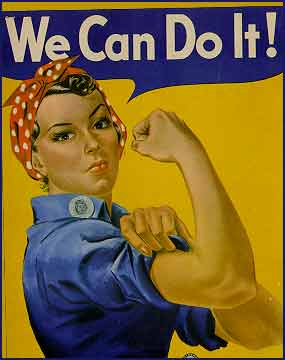
For me, the main problem with this phrase is that it exists. What we should be discussing, in my opinion, are strong characters – or perhaps, in certain circumstances, female characters. If reviewers, agents, editors, readers, and writers started throwing around the phrase “strong male characters,” the ludicrousness of the female counterpart becomes clear. By specifying that these desired strong characters are “female,” it implies to me:

1) That most female characters are weak.
AND/OR
2) That most females are weak.

3) That most male characters are strong.
AND/OR
4) That most males are strong.

5) That gender alone makes these different topics.

Which brings me to my next point, as evidenced by my “and/or” options. The very phrase “strong female characters” is confusing. Are people who seek “strong female characters” looking for female characters written strongly, or characters who are strong females? And yes, there is a difference. Let’s break it down.

Characters Who Are Strong Females

What makes a woman strong? There is literal strength. If someone knows martial arts, lifts a lot of weights, or perhaps is very skilled at gun fights, she can justly be called strong. A person can be physically weak, absolutely. Physical strength can be an excellent symbol of moral strength, but I think far too often, physical strength is conflated with moral strength, so that trend has perhaps outlived its welcome.

So then there is moral strength – what in non-literature life we call “strength of character.” Can someone stand up for what she thinks is right? Does she know what she wants? Has she weathered obstacles? Persevered? The problem, of course, is that moral strength is not only subjective, but ambiguous as well. Is the stay at home mom a societal hero, bucking pressure to do what she believes is right, or is she weak for sacrificing her career and power position in society to fill traditional roles?

The problem with “strong female characters” becoming more and more masculine is quite simple: it implies that men are innately strong and women are innately weak. This is not about literature at all actually, but about our society. If we think the ass-kicking assassin is stronger than the wife who bakes cookies – based on that information alone – that’s a reflection on our own gender views, not on books. (And by the way, wearing heels while you beat up bad guys doesn’t make you “girly,” it makes you totally impractical and probably overly sexualized.)

“Masculine” and “manly” should not be synonyms for “strong.” “Feminine” and “girly” should not be synonyms for “weak.” No, really. This is part of what I love so much about Zooey Deschanel’s character Jess on New Girl. She is ultra-feminine and girly and happy and it doesn’t make her weak at all. In fact, that she’s embraced who she really is makes her super strong, in my opinion. “I brake for birds, I rock a lot of polka dots, I have touched glitter in the last 24 hours…” If you assumed Jess would be weak based on that, you might want to rethink.

[Side note: I’m not bashing “masculine” women/characters. I love masculine women, as long as that’s who they feel they really are. I just don’t think women should “hide” or “subdue” their femininity because they think it’s a weakness, and I don’t think masculinity should be used as a measure of a character or person’s strength.]

Female Characters Written Strongly

So are there weak women? Sure. It’s subjective, as I established above, but all people find certain other people to be weak. Maybe they’re too selfish, with few redemptive qualities, or maybe they let people walk all over them and don’t stand up for what they believe. Maybe they run from who they really are. Whatever the deciding factors, weak women exist because weak people exist. Does that mean that weak women can’t make strong characters? Not if you interpret the phrase to mean female characters written strongly.

Most people would agree that well-written characters:

1) carry the story (meaning they have a story worth telling)
2) seem three-dimensional, complicated, and life-like
3) are emotionally engaging
4) are flawed and conflicted
5) grow and/or change (dynamic)

The execution of these criteria is just as subjective as what makes women strong, so there’s always plenty of room for debate. But I’m going to take a much-cited “weak female character” to make my point: Scarlett O’Hara from Margret Mitchell’s Gone with the Wind.

Now, many if not most people find Scarlett to be a weak person. She’s selfish, spoiled, materialistic, narcissistic, greedy, and somewhat wishy-washy. I believe she has redemptive qualities, too, but let’s agree for the sake of discussion that she’s a “weak” woman overall.

And yet… whether you love her or hate her, she’s one of the strongest, most memorable characters in all of literature. Why?

Her story is the central story, and it’s one worth telling. She’s vivid, lifelike, and multi-faceted. She’s emotionally engaging. She’s deeply flawed and equally conflicted. She grows and changes from the beginning of the book to the end, showing that’s she’s dynamic. By the end of the book, Scarlett has become real to us, and it doesn’t matter if we like her or not. She’s that well-written.

None of those things make her a “strong woman.” All of them make her a “strong character.”

The Vast Array of Strong Female Characters

To prove how little this phrase means, here’s a sample of some of my favorite “strong female characters.” I’m not going to explain why or sort them into which way I mean, just to show how useless this concept is:

Anita Blake
Catherine Earnshaw- Wuthering Heights
Scarlett O’Hara- Gone with the Wind
Jane Eyre
Carrie Bradshaw- Sex and the City
Liesel Meminger- The Book Thief
Oedipa Maas- The Crying of Lot 49
Cherry Darling- Planet Terror
Lennie Walker- The Sky is Everywhere
Annah- The Dark and Hollow Places

I think you’d be hard-pressed to pick out exactly why I think these female characters are strong, and whether it’s because they’re strong people or strongly portrayed.

So my vote? Let this phrase die. At best it’s vague and subjective; at worst it’s confusing and sexist. Instead, let’s talk about female characters, strong people, and well-written characters, with specific traits that we like.

What are your thoughts?
Posted in Reading | Tagged , , | 32 Comments

The Immortality of Books

Have you ever noticed that book reports, synopses, reviews, and query letters are written in present tense, even if the book they’re about is told in past tense? Have you ever stopped to really consider why (beyond the fact that it’s how your grammar teacher told you to do it)? I got to thinking about this the other day, and the whole concept fascinated me.

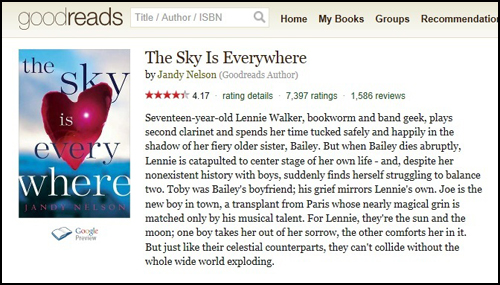
A screenshot of the plot summary for The Sky is Everywhere by Jandy Nelson on Goodreads,
which, by the way, I highly recommend to everybody.

If I shuck my familiarity with this convention long enough to view it logically with fresh eyes, the whole practice seems utterly counter-intuitive. There are other options that strike me as much more reasonable, namely:

1) Write the summary in the same tense as the book.

So The Sky is Everywhere would still be present tense, but Off Season by Jack Ketchum (which I also highly recommend, though not to everybody) would be summarized in past tense.

2) Write all summaries in past tense, sense the person summarizing them has already read them, and thus the events have already happened.

I mean, think about it. Even if you’re currently reading a book, you usually talk about it in past tense. Your spouse walks through the room and you say, “Anita just got them all in big, big trouble,” not, “Anita is getting them all in big, big trouble.” That sounds… not wrong, just odd. Even future tense (“Anita is about to get them all into big, big trouble.”) sounds more natural than that.

But, as I’ve already established, only one of these options is accepted — and the most awkward one at that. All summaries are present tense. Why?

To answer that question, I had to take my mind off the writer of the review and the writer of the book and train it on the reader of the review – and thus the potential future reader of the book.

Future is the key word. That reader has not yet read the book, so for them, the events in the summary have not happened. I’ll let that sink in a minute.

The plot is frozen in time, ready to verb itself into action when you read the words. Until then, it’s like it doesn’t exist. It’s waiting to happen. What an incredible concept.

If you haven’t read a book yet, nothing in the book has happened yet, so the summary wouldn’t make sense in past tense. And since summaries are almost always written for those who haven’t already read something, they belong in present tense. Hell, they could be in future tense if it weren’t so damn clunky.

This tells me several rather wonderful things:

  • Books, quite literally (pun intended), never die, because they’re always happening.
  • Books are always waiting for someone new to read them, to re-happen.
  • Books are not endless. Every book I’ve ever read has ended. But they are never-ending, as someone new can always pick them up.
  • When you think of it that way, books are immortal.

I don’t know about you, but that gives me a lot of joy to think about. Now I would like to pose a tiny little question.

Is that, perhaps, maybe, by any chance… the reason we all so desperately want to publish one?

Is it possible that it’s why we like to read them? Re-read them? What do you think? Am I over-romanticizing it, or are books our best shot at immortality?

Posted in Books | Tagged , , | 9 Comments

Book Title Poems

The Setup

So a few weeks ago, I came across this post on Art of Trolling. Heads up: it’s naughty, but quite amusing. And more than a little silly. And even so, I thought, “Wow, that’s really cool.  I wonder what else you could do with that,” before forgetting about it.

Then last week Judy Clement Wall posted a blog sharing her poem arranged from book titles. J’s effort is, as is everything she does, quite lovely.

For me, it was one of those moments when the perfect combination of ideas comes together. I am obsessed with book titles. I love poetry. What’s more, I actually am a poet. I also am quite partial to crafts and projects, not to mention that I’m madly in love with physical books, of which I have many to choose from. Clearly, this is a concept that was meant to be my soul mate.

I immediately set out to write a book title poem of my own.

My Attempts

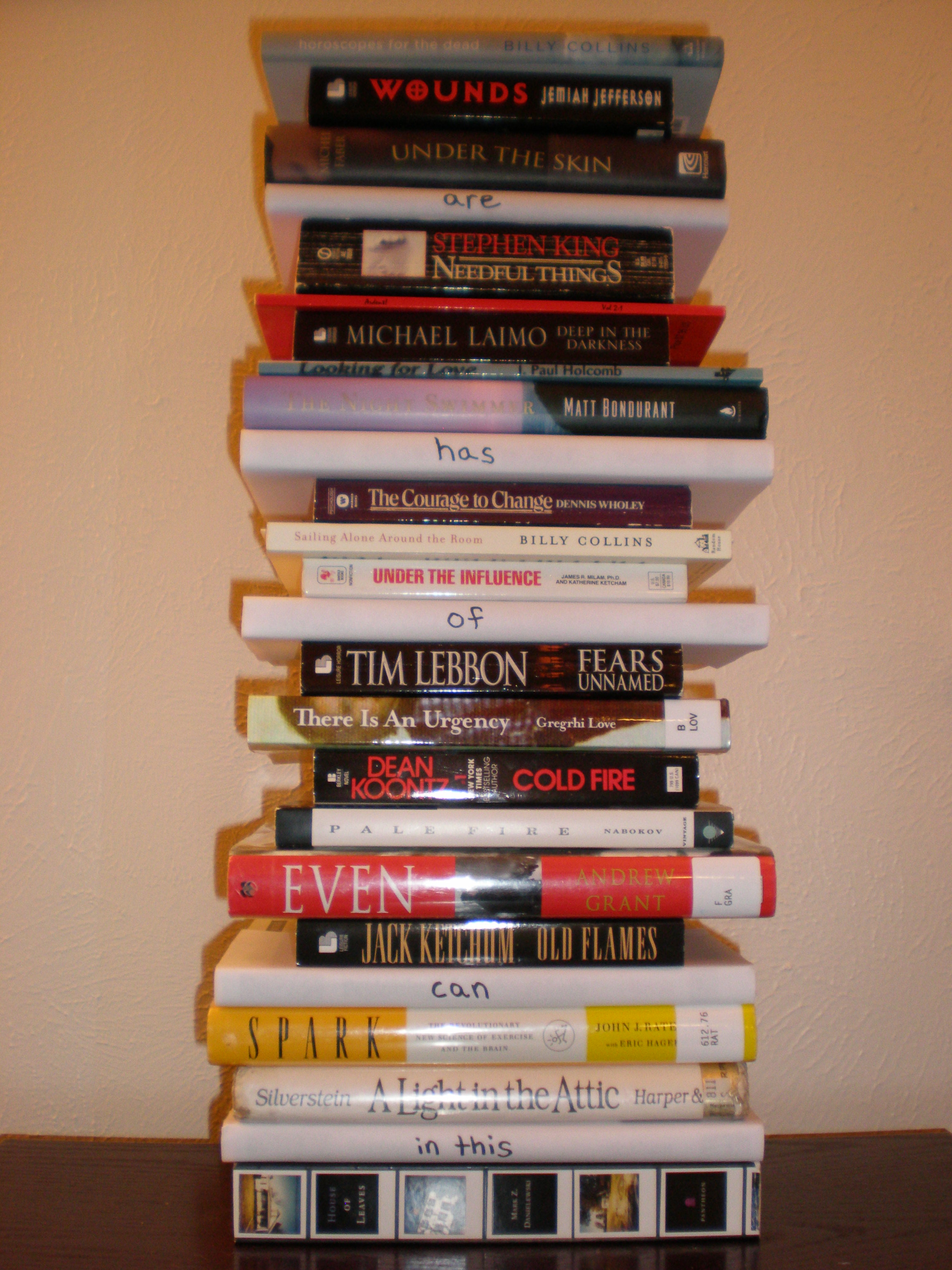
(You can click on these pictures to enlarge them.)

Horoscopes for the Dead

Wounds
under the skin
are
needful things –
ardent,
deep in the darkness,
looking for love.

The night swimmer
has
the courage to change,
sailing alone around the room,
under the influence
of
fears unnamed.

There is an urgency –
cold fire,
pale fire.

Even
old flames
can
spark
a light in the attic
in this
house of leaves.

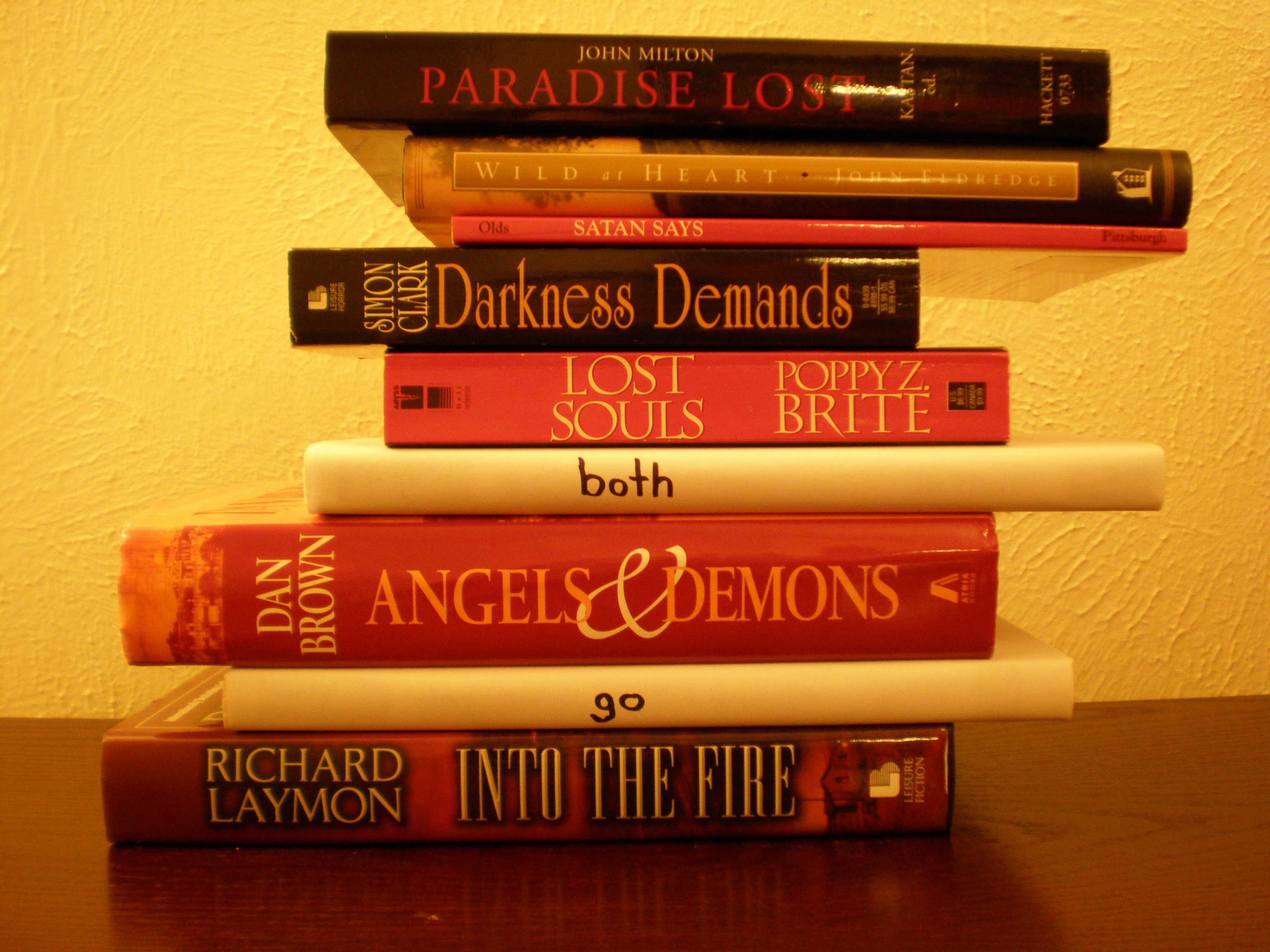
I liked this one, but it was too long for the picture to look good and the titles to be readable. So I tried a shorter one:

Paradise Lost

Wild at heart,
Satan says,
“Darkness demands
lost souls.
Both
angels and demons
go
into the fire.”

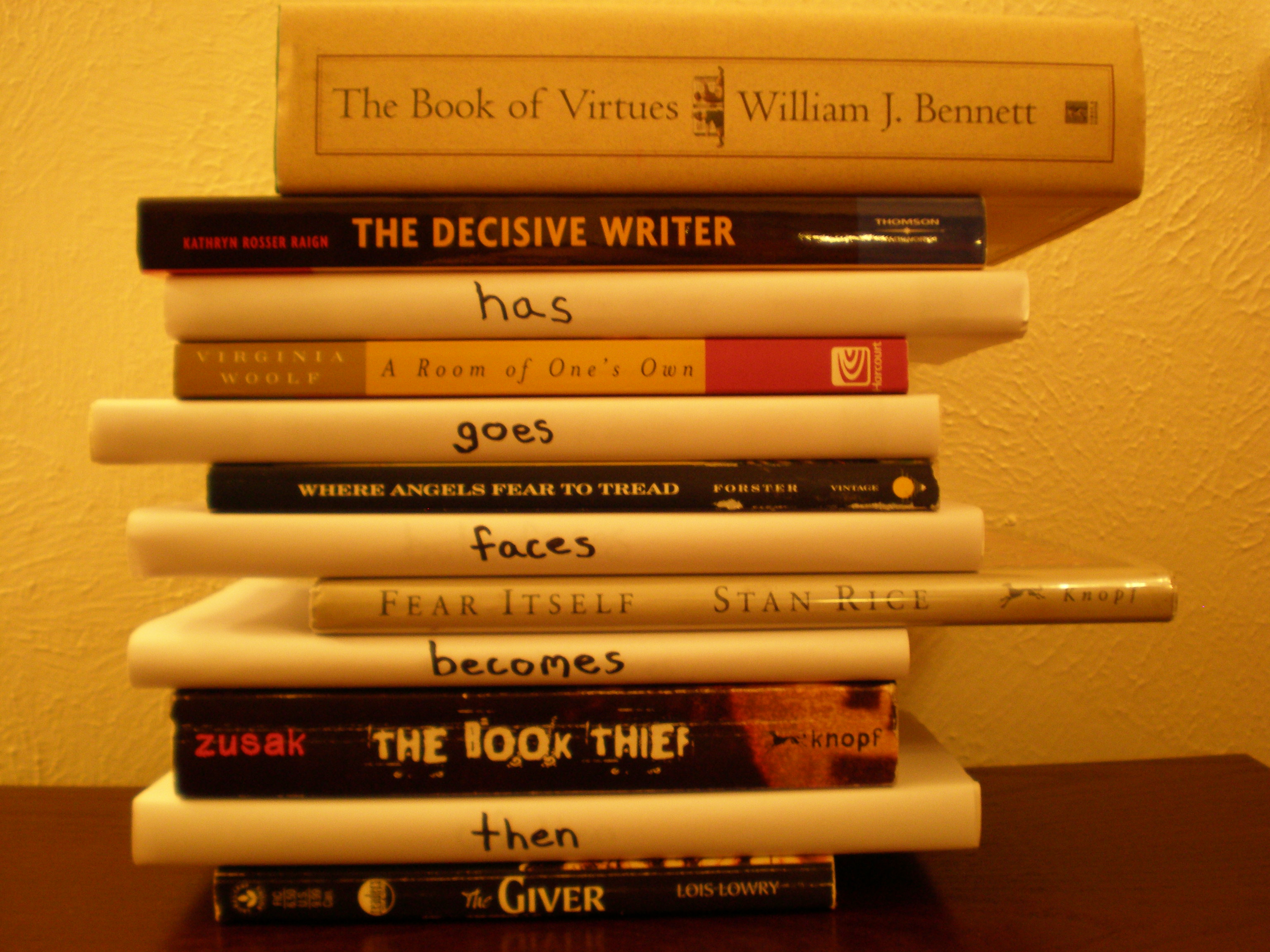
This one’s much more photogenic, but perhaps a little dark. (Hey, I have a lot of horror novels. What can I say?) So I tried for one more, both short and less heavy:

The Book of Virtues

The decisive writer
has
a room of one’s own,
goes
where angels fear to tread,
faces
fear itself,
becomes
the book thief —
then
the giver.

How to Write a Book Title Poem

The first thing I did was begin pulling books from my shelves based on titles. Yes, this destroyed my beautifully organized bookshelves, but it was worth it. I took down titles that caught my eye for one of these key reasons:

1) They were poetic already.
2) They were particularly pretty covers.
3) They caught my mind by being somehow tied to another one I pulled.
4) I figured they would be useful phrases.

Now, I pulled way more books than I used. But that’s part of the fun.

I started messing around by stacking my favorite choices, trying to make the phrases fit together to make sense as a free verse poem. Once I had a good little section, I started browsing my shelves for specific things, like verb titles or phrases to be used as an adjective, etc.

When I got to the point that I had a decent stack with some holes, I sat down at my computer and typed up the lines, leaving blanks where something was logistically missing. Then I filled them in. The blanks were either 1) a short word or phrase that I could write on a blank book cover, or 2) something bigger than that. For the 2nd, in my longer poem, I simply went to my local public library’s website and started searching the catalog for words I needed. Bingo.

Finally, I made the book covers (just wrapped the spines of spare books in blank printer paper and wrote the words in), stacked them in order, and snapped a photo. Then I wrote out the poem and capitalized/punctuated it the way I wanted, because in the photos the titles can be a bit tough to read. Voila. A book title poem.

The Rules

These were, of course, self-imposed. As far as I know, there is no official Book Title Poetry Board of Snooty Regents.

1) No extra words (i.e. I couldn’t just ignore words that I didn’t want to use).
2) Keep covered books to a minimum.
3) Covered books could be used only for small phrases or single words.
4) Use mostly books I own.
5) One title per line of the poem.
6) Make it pretty.

The Challenge

So there you have it. I hope you love the idea as much as I do. If so, why not give it a go? I would love to see what y’all come up with. And I found it to be a really fun way to stretch my creativity.

If you do make a book title poem and blog/tumblr/flickr/whatever it, please come back here and paste the link to that post in the comments. Or if you don’t have a blog/don’t want to do a post on this, feel free to paste the text of the poem in the comments. Get as creative as you want: color themes, DVD cases, all books by one author, etc. I can’t wait to see what y’all come up with!

Where to Read More

I do hope that you guys want to play, but if not, at least I had fun and got to share this neat idea with you.

Are you like me and can’t get enough? Aside from the two at the top of this post, here are some more book title poems I found online:

  • What Rhymes With April? by Stacy Post at A Writer’s Point of View
  • Take A Look It’s On A Book by Abigail at Oh My Words!
  • Flickr by the The Northern Onondaga Public Library
  • Book Title Sentence Poem by Karin and Julie at Edifying and Edgy
  • Write Poetry with your Bookshelf by Meredith Ann Rutter at The Blog Farm
  • A Poem of Novels by Tahereh Mafi
  • Stack Poetry by Valette Keller at Rhapsodic

Happy title poeteering, my loves! =)

Posted in Poetry | Tagged , , , | 23 Comments

The Air in Our Apartment

I was thinking the other day about my journey as a writer. Something about starting my fourth novel has got me feeling nostalgic, as you might have guessed from my school bus post.  I think it’s that I’ve suddenly realized that I measure my life not in years, but in novels.

2007 was my very first book. That year was rough, depressing, and full of painful naiveté. 2008-2009 were the years I couldn’t find the time or energy to work, since my dad died and I was just desperately trying to stay afloat. 2010 was Book 2. 2011 was Book 3. And now, I am keenly aware that 2012 will become – and always will remain – Book 4.

It’s hard to put into words all of the things I have learned in the past five years as a full-time writer. It’s incredible to think about how far I’ve come. Maybe someday I’ll do a few posts where I share what I’ve learned (although I do have this category tag that houses some of the advice I’ve come up with along the way) but today I just wanted to share with you that first moment of joy.

My very first success came in the form of an email on April 6, 2010. The Wichita Literature and Art Review, a relatively new literary magazine in the north Texas region, wanted to publish two of my poems: “The Air in Our Apartment” and “Digital Implications.” I reread the email three times to make sure there wasn’t a mistake – so much blood rushing to my head that I’m actually a little surprised I didn’t pass out – screamed, and proceeding to generally scare the shit out of my cat by dancing around the house and sporadically rushing back to my computer to make sure that the email was still there.

Then I called my mom. And perhaps everyone I knew, although I can’t remember. I might have just posted the news on Facebook.

It was surreal. I always knew my work was good enough to be published. Not that I was arrogant, but I really did have faith in my talent. I still do. I can’t imagine submitting something I didn’t believe in. Not to say that this poem is the best I’ve ever written. It’s certainly not. But it holds such a sweet space in my heart for the sake of being the first one I ever had professionally published. It appeared in Volume IV of The Wichita Literature and Art Review.

The Air in Our Apartment

As I see the specks and motes
of pale dust
floating, suspended in horizontal light
sifting through the blinds,
I remember:
dust is primarily skin cells
that die and slough off,
landing on a shelf of knick-knacks,
the tops of doors,
the carpet…
or like these adventurous spirits
continue to hover in the air,
wandering in the light
of our apartment.
It is our apartment, you know.

I wonder
if the memory in each cell
of what its role was in our bodies
communes with the memory
of the cells it meets
as it bumps along.

And so maybe, then,
we should be more creative in our lovemaking—
match up more non-standard parts…
an elbow to a calf,
a nose to the back of a knee,
a navel to a toe…
so that when the cells
shed and drift,
when they make their greetings,
they can hail each other as old friends
rather than introducing themselves
for the first time
in the air of our apartment.

© Annie Neugebauer
All rights reserved.

Five days later, Dos Gatos Press accepted another poem, “Approaching June,” for publication in the 2011 Texas Poetry Calendar – an even bigger venue. My happy dance turned to a happy cry, and I knew I was going to be able to do this.

I still know that I’m able to do this. Poetry, stories, novels, all of it. The things I’ve always dreamed of are attainable. I’m just in the middle of the ride.

Now I’m off to work on novel number four, remembering that if I work hard enough, there is a pay-off. The work is worth it. Success, in any degree and at any level, is sweet.

I hope you all have a good, productive week. =)

Posted in My Works | Tagged , , | 14 Comments

25 Beautiful Unique Book Titles

Titles are very important to me. For poems and stories, I like it when the title adds something to the piece itself rather than labeling. Labeling is effective for essays and sometimes novels (to a lesser degree), but for short, creative pieces, I like to take advantage of that extra line to do something special to the piece. I’m fond of one-word titles that have multiple meanings (maybe as both a noun and verb, for example). I also like it when a poem is about something without ever telling you what it is, but then the title does.

Titles are fun tools, and I wish more writers used them to their full advantage. So many times it seems like a quick afterthought. If the title doesn’t seem perfect, I’m dissatisfied – including my own titles.

I’ve been trying to figure out what to use as a working title for my new horror manuscript, and I keep drawing blanks. Working titles are often changed in the end anyway, but I’d still like to have a good one. It affects the way I think of the book as I’m writing it. And if it’s really good, it might stick around all the way to the end.

In an attempt to unblock my title impasse, I decided to make a list of all of my favorite book titles. It hasn’t helped yet, but it sure was fun. =) Here they are, in no particular order, with a few notes of my own:

1. The Forest of Hands and Teeth, Carrie Ryan
This title is actually why I first picked up the book.

2. Something Wicked This Way Comes, Ray Bradbury
This is a phrase from Shakespeare’s Macbeth: “By the pricking of my thumbs / Something wicked this way comes.”

3. *Where the Sea Breaks Its Back, Corey Ford

4. Wuthering Heights, Emily Brontë

5. ‘Salem’s Lot, Stephen King
Originally titled Second Coming, but later changed to Jerusalem’s Lot, and finally shortened to its final version to avoid sounding “too religious.”

6. *Exactly Where They’d Fall, Laura Rae Amos
This book isn’t actually out yet, but I had to include it. Even if I wasn’t online friends with the author, I would buy it for its title alone.

7. The October Country, Ray Bradbury

8. Of Mice and Men, John Steinbeck
This is a phrase from Robert Burns’s poem “To a Mouse,” which reads: “The best laid schemes o’ mice an’ men / Gang aft agley.” (The best laid schemes of mice and men / Often go awry.)

9. *House of Leaves, Mark Z. Danielewski

10. Wide Sargasso Sea, Jean Rhys
The Sargasso Sea is a region in the middle of the North Atlantic where several major ocean currents deposit their debris. Sargassum is a type of floating seaweed. This is a literary “prequel” to Charlotte Brontë’s Jane Eyre.

11. The Dead-Tossed Waves, Carrie Ryan
What can I say? She’s good at titles.

12. *No Country for Old Men, Cormac McCarthy

13. It Was On Fire When I Lay Down On It, Robert Fulghum
The author of the collection, All I Really Need to Know I Learned in Kindergarten, which was also a clever title until everyone beat it to death.

14. Who Will Run the Frog Hospital? Lorrie Moore

15. *Full Dark, No Stars, Stephen King

16. The Lives of the Heart, Jane Hirshfield

17. The Art of Drowning, Billy Collins

18. *Long Dark Tea Time of the Soul, Douglas Adams

19. A Ring of Endless Light, Madeleine L’Engle

20. The Radiance of Pigs, Stan Rice
Random fact: Stan Rice (deceased) was Anne Rice’s husband.

21. Pale Fire, Vladimir Nabokov
This is a phrase from Shakespeare’s Timon of Athens: “The moon’s an arrant thief, / And her pale fire she snatches from the sun.”

22. *Silence of the Lambs, Thomas Harris

23. Queen of the Damned, Anne Rice

24. The Crying of Lot 49, Thomas Pynchon
Auction items are called “lots.” The auctioneer is said to “cry” a lot when he takes bids on it. This novel ends with the crying of lot number 49. But it’s not as dull as it sounds, it ties into the plot, which is not about auctions at all.

25. The Sky is Everywhere, Jandy Nelson
I must say, this book is even more beautiful than the title – a rare find.

*Denotes books I haven’t read yet.

As you can see, for novels and book-length works I tend to lean toward long, phrasal, and poetic titles. They just really grab my attention and then stick with me. Not to mention that they whisper, “The writing inside is just as good.”

I want a title like that for my new WIP (work in progress). Maybe you can help me get new ideas. What are some of your favorite book titles?

Posted in Books | Tagged , , , | 34 Comments