10 Poems: Recommended Reading

I think it’s safe to say that I’m in a slump. This happens to me every February (my mom calls it my “February Funk” – the fact that it has its own name tells you how regular of a thing this is) as well as after every big project is completed and I’m not sure what to work on next. This year, those two things are coinciding for a super-mega-slump-of-doom.

All this to say I couldn’t think of anything to blog about this week. Since my own words won’t do, I hope you’ll forgive me for instead directing you to some words by others that always touch my heart. Below, ten poems I’d love for you to read. (These aren’t in any type of order.)

1. “The Day is Done” by Henry Wadsworth Longfellow

This poem absolutely must be read at night right before bed. If at all possible, have someone you love read it to you, slowly and softly. I tear up most times that my husband reads it to me; it’s just so perfect.

2. “Litany” by Billy Collins

If you love a little bit of dry humor in your poetry – as well as a healthy dose of exquisite phrasing – this one’s for you. How Billy Collins entwines the two so perfectly is beyond me.

3. “Stopping by Woods on a Snowy Evening” by Robert Frost

I find that this poem of Robert Frost’s is less talked about than others, even though I think it’s one of his masterpieces. I suggest: read it once literally, and then read it again as a metaphor for suicide.

4. “Invictus” by William Ernest Henley

Man, even in a heavy slump this poem touches me. Every line is packed with power; if this one can’t make you feel inspired, I dare say ye have little hope.

5. “The Writer” by Richard Wilbur

Writers, this is a must-read. If you don’t read any of the others on this list; read this one. Even if you hate poetry. I promise.

6. “Do Not Go Gentle Into That Good Night” by Dylan Thomas

Another one that will make you cry, if you let it. This one is a villanelle, which is a form of poem heavily rhymed and repetitive, so it might not be for all modern readers, but if you can let the rhythm of it sink in, I think you’ll find it powerful.

7. “To Science” by Edgar Allan Poe

I would be remiss not to include some Poe here, but I wanted one you might not have read. This is a sonnet – and it’s not perfect – but I think it’s well worth a read. If nothing else, I think everyone should know that Poe wrote about many things besides spooks and death.

8. “Night is my Sister” by Edna St. Vincent Millay

By now… you’re probably realizing that I tend to gravitate towards dark, powerful poems. This is another one (another sonnet), and it would be difficult for me to explain how deeply this speaks to me. It feels like one I almost could have written myself in a different life.

9. “If Only We Had Taller Been” by Ray Bradbury

This poem is a beautiful example of free verse, and it’s also a nice “conversation” poem with Poe’s “To Science.” Bonus: this link comes with a video of Bradbury reading the poem. If you’re feeling impatient, you can skip to 2:20 in where he actually starts reading, or just scroll to the text below the video.

10. “A Room” by Jane Hirshfield

If this poem doesn’t convince you to read Jane Hirshfield, I don’t know what could. I love it so much I actually wrote to her and included one of my own poems that’s modeled after it. I think it speaks to what a lovely person she must be that she took the time to write back.

~*~

So there you have it: ten poems I think you’ll find well worth your time. I hope you all have a great, slump-free week.

Posted in Poetry | 23 Comments

Why Some Novels Say “A Novel” on the Cover, and If Yours Should Too

Ever notice how some novels have “A Novel” written right on the cover, under the title? Maybe you have but haven’t thought about it. Or maybe it drives you insane. But if you tread in bookish enough circles, the subject will come up eventually.

The gist of it is… why? It seems obvious and redundant, possibly even snooty and declarative. Some people love it, some hate it, but no one seems to quite know why it’s done. I have some thoughts!

A Brief History

Now I’m not going to drag you through a complete history lesson of the novel, but I will say that as a literary format, it’s a relatively new invention. Lyrics, poetry, plays, journals, and essays are all much older. The novel, roughly recognizable as how we think of it today, didn’t gain any continuous popularity until the 18th century.

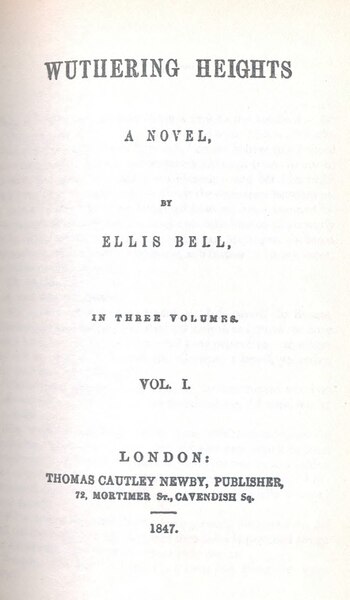
Take, for example, the first edition of Wuthering Heights.

Wuthering Heights

You can see on the title page that it says “A novel by [Emily Brontë’s pen name]”. This was published in 1847. Nowadays, a book with this title would likely leave off “a novel” and shelve it under fiction. But that’s because for us, today, a novel is the default. (That format won the literary battle, for now. Hurrah, novels!) If we’re told to read “this really good book,” most of us will assume it’s a novel unless otherwise specified.

Back then, however, people were still assuming things were essays, memoirs, travel journals–not to mention that people didn’t just take a bus to the library or order something off Amazon, where the genre was clearly labeled on the shelf. So you can see that “a novel” under the title served a necessary function.

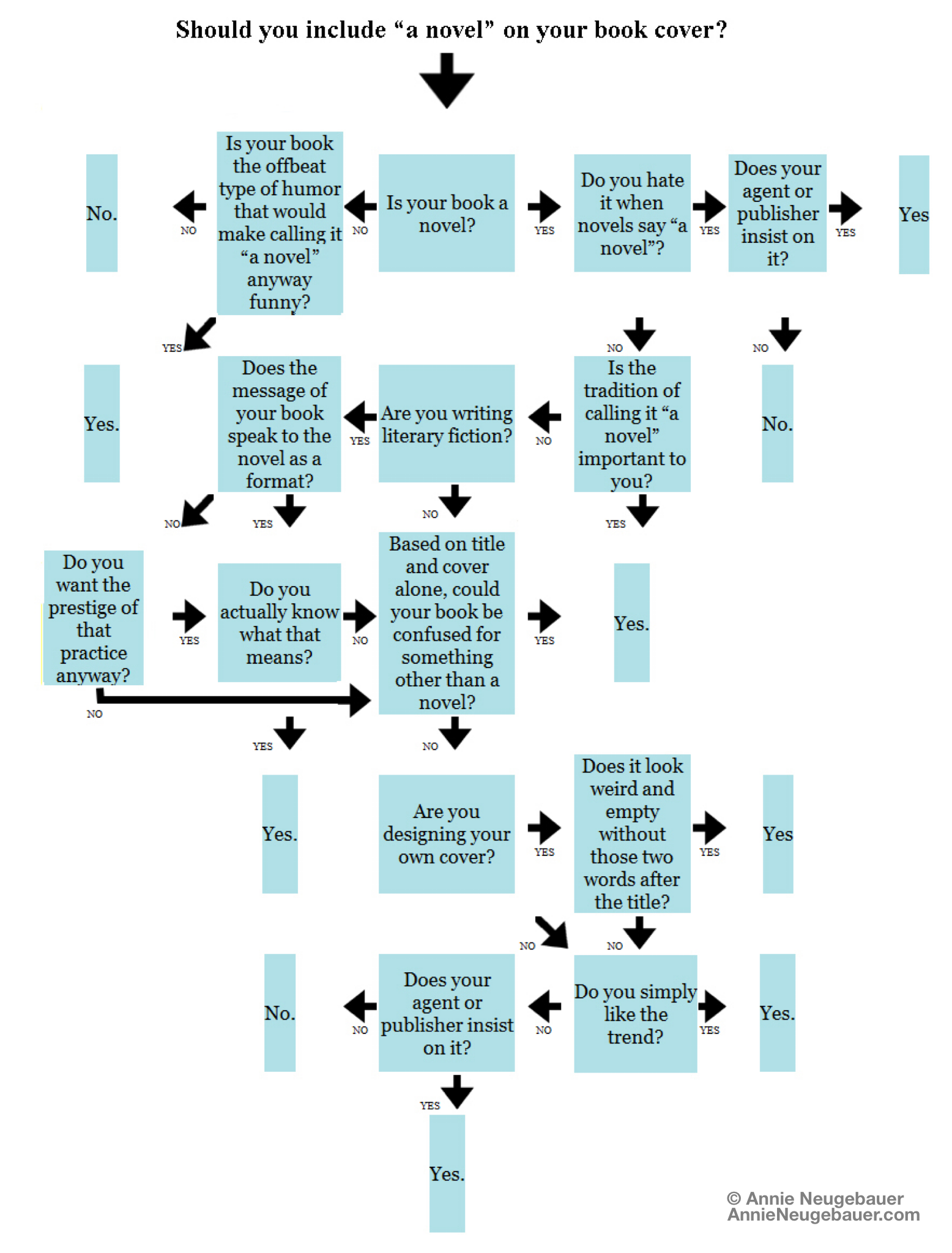
That’s all well and good, but now that “a novel” is pretty much the default these days, why has that little clarification stuck around? It isn’t cut and dry, but my best guess is that there are several reasons, often more than one at a time. I’m going to hit the highlights below, followed by a flow chart so you (if you’re a writer) can decide if you want those two little words on your book, too.

Reasons People Use it Now

Tradition– Tradition is a heady thing. Wedding vows, national symbols, school colors: our lives are steeped in it. There’s something powerful about tapping into an experience or symbol that generations before have also experienced. In one way, it makes us feel more grounded, more connected to the past. It can also be a way of acknowledging one’s lineage, tipping the hat to those who paved the way. Tradition is in most facets of our lives. Why should literature be the exception?

Literary device– Remember how literary fiction uses devices outside of plot and character to send a message? Sometimes (more often than you might think) that message involves literary history, the act of writing, the art of storytelling, the format of words… in short, it involves novels themselves. In this case, literary context becomes a device. Which is part of why you see “a novel” on so many works of literary fiction, specifically. Those two words are already communicating with you; they’re setting you into the frame of mind to understand the message.

Prestige– And because literary fiction authors have used “a novel” often enough as a literary device for it to become noticeable… no doubt there have been other authors simply trying to cash in on this association. Literary fiction has quite a bit of prestige in some circles, and those who want in might use this to their advantage. Now, who’s doing it to further their message and who’s doing it to add some clout to their name is subjective.

Clarity– Is Eat, Pray, Love, a memoir, a self-help book, or a novel? You know if you’ve read it, but if you haven’t… you really might not. What about Goodbye, Columbus? How about A Thousand Mornings? Even Who’s Your Mama, Are You Catholic and Can You Make a Roux?* If an author (or publisher) is worried that the book could be misinterpreted from the title and cover alone, they might stick “a novel” on there just to be safe. With the growing prominence of online purchasing–where genres are a tag down at the bottom rather than a shelf you walk up to–this is not necessarily a paranoid choice.

Assertion– On a related note, have you ever noticed that many experimental novels have “a novel” on the front? It’s almost like they’re saying, “I know I messed with some things, but, really, this is a novel; I promise.”

Layout– I really think that designers sometimes include these two little words to help visually balance the layout of the cover. Length of the title, size and sharpness of the images/background, plus length of the author’s name all affect how a cover looks, and sometimes adding two words in the middle might help. Don’t knock it. These things matter. (Maybe not to you, but to someone.)

Trend– And, finally, the obvious one. The one that most likely accounts for 80% of current books that say “a novel” on the cover: It’s in style! And scoff at that all you want, but covers, titles, even genres come and go over the years; this is just another bit of choice that adds flavor to a book.

*(The answers, in order, are: memoir, novel, book of poetry, cookbook.)
 

Authors, Need Help Deciding?

This might help get you started. (Y’all have no idea how long this took me.) Click chart to enlarge.


So, what do you think about this practice?

Authors, did you include “a novel” on your book? Writers, do you plan to?

Posted in Books | 31 Comments

Tips for Greater Productivity, part 2

geared towards people who work at home, especially writers

This is the second half of my productivity tips list, so if you missed part 1, don’t forget to check it out!

6. Schedule both fun time and chill time.

And yes, they are different things. Fun time is for things like bowling with your kids, going on a weekend hike, or checking out your local Zumba class. (Notice how these are all active things that might give you endorphins.) Chill time is for things like TV marathons, lazy evenings on the couch with your spouse and pets, and luxury naps. (Notice how these are all snuggly things that might up your oxytocin levels.) Both are necessary for a healthy body and brain, so give yourself time to do one of each at least once a week. If you can’t find time, make time. A refreshed self is more productive than a continually exhausted self.

7. Get busy. (Not to be confused with fun time.)

This one is counter-intuitive. But have you ever noticed that when you have a bit of a time crunch you can pound out 1,000 words in a single hour… words that you often can’t get over an entire half-day? There’s a reason for this, and it’s the same one high school students have been using as an excuse to do last-minute papers for decades: our brains often work better under slight stress.

My point is that if you aren’t at least moderately busy, you might be less productive even though you have more time. So if you work at home and see that your day is wide open with nothing but one goal, throw some other things in there. Tell yourself you’re going to go get the oil changed today at 2, and that you have to accomplish your goal before then. You’ll likely achieve that new goal—and get your oil changed to boot. It’s a win-win.

And if you routinely find yourself with lots of empty time, it might be time to increase your goals.

8. Turn off the freaking interwebs.

Look at your laptop keyboard. Do you see near the top what looks like a little phone tower with motion symbols coming out of it? That’s the wireless button. (You desktoppers will have to do it the old fashioned way, from the control panel.) That button: push it. “But Annie, won’t that turn off the internet?” Yup.

9. Be hard on yourself.

There probably isn’t a therapist in the world who would tell you this, but lucky for us… I’m not a therapist.

Working for yourself is like going to the gym; it’s innate human nature to cheat. The reason personal trainers and fitness classes work better than telling yourself “you’ll do it at home” is because we are always sneakily trying to figure out ways to go easy on ourselves. It’s in our genetic makeup to conserve energy—both physical and mental. So, just as you might let yourself go 5 pounds lighter at the gym than your trainer would, you might just go several tasks lighter on yourself at home than a traditional boss would.

There’s no easy fix for this. The goals help, as does the schedule. In the end, you have to constantly remind yourself what you’re capable of.

You have to work hard. You have to push yourself beyond what you think you’re capable of, or you’ll never test your limits. I tell my husband all the time that I’m a much tougher boss than any bosses I know, and it’s true. If you want to be productive, you need to be hard on yourself.

10. But not too hard.

That being said… there’s a limit. You don’t want to cross the line between pushing yourself toward productivity and bullying yourself. That’s why we schedule in fun time and chill time. And if your own boss (you) ever brings you to tears with her harshness… tell that chief to eff off and go take your lunch break early. She’ll understand.

11. Get enough sleep.

You know that expression “I’ll sleep when I’m dead”? I think it’s one of goofiest things I’ve ever heard. People need sleep. You know what happens when you don’t sleep? You die. So… yeah, I guess you will “sleep when you’re dead”… and it will be a lot sooner than the rest of us.

Snark aside, not getting enough sleep is a huge problem in our society. When I was in college, people were always surprised by how regularly I maintained high grades. They’d ask me how I did it, and there were really only two answers: 1) Review new information within 24 hours of learning it, and 2) Get at least 8 hours of sleep every night. Not kidding. Most people could get high grades if they religiously followed those two rules.

The mistake so many people make is cutting sleep during the week and “catching up” on the weekend. The problem with this (aside from the fact that sleep is directly tied to the immune system, and a lack of sleep will lead to increased illness, which will lead to decreased productivity) is that the brain needs sleep each night to process, sort, and store all of the information of that day. If you miss sleep that night, there’s no going back; that information (or some of it) will be lost—inadequately stored. So while, yes, you’ll sleep more that weekend because you’ll be tired, it won’t reverse the negative effects of skipping sleep during the week. There’s no such thing as “catching up on sleep.”

A rested brain means a higher-functioning brain. A higher-functioning brain means faster, higher-quality work production. Get your eight hours each night so your noggin is ready to go each morning. Plus, you’ll get rid of that dragged-out-of-bed–by-an-angry-raccoon feeling, which is always nice. Speaking of which…

12. Make the bed.

I thought about writing a whole paragraph here about how starting your day off with a neat, lovely, productive attitude sets the tone and gets you in a positive frame of mind (and there is truth to that — no, really)… but then I realized that I just prefer when people make the bed.

So make the bed.

~*~

What did I miss? Do you find yourself wishing you were more productive? Do you have any extra tips you can share with my readers? Jump in below!

Posted in Advice for Writers | 23 Comments

Tips for Greater Productivity, part 1

geared towards people who work at home, especially writers

I have been called plenty of things in my life, but I don’t think “lazy” has ever been one of them. Workaholic, anal-retentive, perfectionist, slave-driver, and bossy? Sure. Lazy? Not so much. Say what you will about that—and I’m sure you could pin this personality trait on plenty of unhealthy things—but in the end it serves one purpose splendidly: I get shit done.

So I thought I would share some of my principals and tricks with you guys. Turns out, I have a lot! So this will be in two parts for a total of 12 tips that make me a busy and productive bee.

1. Make goals.

Omg. Seriously? This tip isn’t new. I’m not saying it is, but here’s the thing: it works. Especially for people who work for themselves, like most writers. Every single time I find myself floundering for a week, drifting from project to project, or wasting entire days doing nothing but rechecking Twitter, it’s because I’ve forgotten to set new goals.

I’m not going to talk about what type of goals to make or how (well, not much anyway), because, dude… google it. Besides, most of us have had at least one teacher along the line make us fill out a worksheet about short-term and long-term goals. We get it. And most of us believe it, but that doesn’t mean we remember to make like Nike and just do it. This is especially crucial when you come to the end of a goal. So you actually finished your first draft when you said you were going to—awesome! But now what? Time to set the next goal.

2. Prioritize those goals.

This is actually something I learned from my husband. One night I asked him to help me set up a schedule for the next day, and the first things he asked me to do? Make a list and number them in order of importance. Factors that affect importance are 1) deadlines 2) productivity and 3) desirability. In other words, editing a certain short story might not be a priority this week, but if it’s due next week it will become one then.

After I did this, I gave Hub-a-dub the list and he made me a schedule. Did I like the schedule? Hell no! He made me do all the hard boring stuff first. (I had been instinctively checking off the more fun or repetitive tasks first as a way of procrastinating. More on that later.) Turns out that was one of the most productive days I’d had in weeks, and now I try to schedule every day this way. Which brings me to…

3. Make a plan (schedule) to reach those goals.

Making goals is all fine and dandy, but in and of itself just isn’t enough. You have to take steps toward achieving them. Which means… *dum dum DUM* a schedule.

Scheduling is one of those things that you just have to DO. *There’s isn’t really a shortcut, as far as I know. You sit down with your goals prioritized in a list + the hours available in your day, and punch them into timeslots. Remember to schedule food breaks and stretching breaks between long, tedious tasks.

4. Make a contingency plan.

Sometimes life gets in the way. Sometimes our goals are overzealous. Sometimes incredible and unexpected opportunities pop up. That’s okay. It’s not the end of the world if you don’t hit your goal on your projected date… unless you have no contingency plan and therefor beat yourself up and have an emotional breakdown.

Instead, make a back-up plan. Shift things around. Take a look at your prioritized list and push back the bottom items. Think of this like a long-term diet or health plan. If you fall off the wagon, don’t go crazy with it. Don’t start all over to punish yourself or give up entirely and go on a binge. Just continue on the next day as if it never happened. You’ll feel better about yourself and waste less time.

5. Procrastinate like a boss.

(The kind that’s slang for awesome, not the kind that means employer.)

My mom called a couple of weeks ago and asked what I was doing. I said, “Procrastinating.” She said, “I’ve never known you to,” and I tagged on, “Well I’m procrastinating productively.” My answer was misleading, but only on the surface. Explaining this long-time practice of the “right way to procrastinate” to her helped clarify it to me.

Fact: It is in human nature to procrastinate. Lesser-known fact: You can use this to your advantage.

Sometimes there are tasks that loom above us like mountains so tall the peak is engulfed in storm clouds. The best thing to do, when you can manage it, is tackle that bitch. Get started, small steps, and you’ll feel less overwhelmed in no time.

But let’s get real; sometimes that just isn’t going to happen. So when you feel that siren call to put off your MegaTask, do what I do: procrastinate by doing something else that’s still productive.

Example: Suzy set herself a goal of rewriting a highly emotional scene in her novel today, and she’s dreading it. She knows she won’t be able to make herself do it today, so instead of giving up and watching TV until she can’t feel her eyeballs, she edits an old short story and sends it out on submission. Or she catches up on her website’s much-needed updates. Or she reads. (That’s part of writer’s job too, you know.) Or if all else fails, she does chores. Hey, who hates a clean house?

If the MegaTask is daunting enough, you’d be amazed by the number of menial, odd-end jobs you can get done in the meantime. I do it all the time: use the fear of one task to spur the productivity of a bunch of others. Eventually, you’ll either have your whole life so in order that there’s nothing left to do but MegaTask, you’ll hit the deadline that forces you to face MegaTask, or you’ll realize MegaTask is something you don’t actually have to do and rearrange your priorities.

~*~

*Is there an interest for a daily schedule template for writers? It would be a free document at The Organized Writer. If yes, let me know in the comments below.

Part 2 is coming next week! Hope to see you back then. Don’t want to miss it? You can subscribe by email or RSS at the top of my sidebar, or follow these instructions to specify which types of posts you’re interested in.

So, which of these 5 tricks work for you? Have you tried them? What are the areas that you most need to improve on?

Posted in Advice for Writers | 22 Comments

The 3 Rules of Revision

Those of you who know me know how much I hate revisions. I really, really do. For me, it’s all the work of drafting with none of the fun. This explains the snark in last week’s comic as well as tweets like this:

At first I just used the angst for Twitter fodder, but eventually it got to the point where I was seriously floundering. I had feedback from four beta readers and much of it conflicted, not to mention that I had my own deep-gut worries. How the hell was I going to fix this mess, and more importantly, which things was I going to “fix,” and which things were actually right the way they are? Well, a couple of things happened. I called on a pretty amazing writing buddy (of which I’m lucky enough to have several) to help me talk it out, since she’d helped me talk out some of these same things before ALL THE FEEDBACK. Some things she just helped me logic through. But the main thing she did was tell me that the way I had some of these things was just right—as my gut was screaming at me all along. I’d become so afraid of unintentionally ignoring good critique out of fear, that I’d gone too far and started ignoring my own writerly mojo. Then I looked up and saw this quote, which I have printed and taped to the top of my computer screen: “Let me be wise in my creation, let me be fierce in its defense, let me be true to my message and my vision.” –Laurell K. Hamilton Funny how when you see something often enough, you forget to really notice it. I’ve always thought this was a beautiful quote, although potentially dangerous in the hands of writers with big egos or a reluctance to let in feedback. But its value is clear. When too much feedback brings in the doubt monsters, you have to go back to your own message and vision, and be true to that. Voilà:

Now I am revising and making progress as should be (even though it’s still totally no fun).

But I relearned an important lesson from my near-loss of revision sanity. Three of them, actually, and I’m going to share them here. The most important thing about them is that yes, they are in order of importance—and that’s what’s so easy to forget.

~*~

1) Trust your instinct.

If you feel deep down that you shouldn’t change something, don’t change it.

Just make sure that your deep negative reaction to a suggestion comes from genuine conflict of vision rather than fear or hurt feelings. Sometimes the critiques we react to most negatively are the ones that we deep down suspect are right. Just like insults that hurt our feelings, they’re worse if we secretly know they’re true.

So if you get a suggestion that makes you mad or sad, don’t reject it out of hand. Let it sit, think it over, and try to be honest with yourself. Do you hate this because you know it’s right and that hurts? Consider changing it. Do you hate this because it just doesn’t jive with your artistic vision for your book? Stick to your guns. You’re the creator; no one can make you change your work.

2) Trust your readers.

Not your beta readers: your future book readers. Rarely are beta readers and critique partners your actual ideal book readers.

I give a lot of critique, and this is one of the things I most often find myself saying. “Trust your reader” means don’t underestimate the intelligence of your audience. Don’t over-explain. Don’t dumb it down. Don’t smack them in the face with clues. Trust them to understand your vision and message, and revise accordingly.

Will all of your future readers get it? No. But the ones who do will love you for it. Write for the few, not the many. Readers, like kids, know when they’re being talked down to, and they don’t like it. Trust your reader, and they will sense it.

3) Trust your critique partner(s).

At some point during the writing process, it becomes necessary to get outside opinions. Writing in a hermetically-sealed bubble can be a good thing, but revising in one usually isn’t.

There’s a caveat to this lesson: you have to have good critique partners and beta readers. Finding them isn’t always an easy thing, but once you do, you’ll know it. And you’ll quickly realize whose tastes mesh with yours, and whose opinions (though always valid) simply don’t match up with what you’re going for. I’m lucky enough to have this, so I know it’s out there. If you haven’t yet found someone who suits what you need, keep looking. A good reader is one of the strongest tools a writer can have.

And once you’ve found one…

Trust them with your work. Trust them with your emotions. Trust them to know how much you can handle, and if they push your limits, trust that they believe you’re ready for it. Trust that they’re being honest, and that they don’t have ulterior motives.

Finally, trust their opinions in every regard except when it conflicts with numbers 1 or 2.

~*~

So there you have it: my three rules of revising. Funny how all three of them come down to trust, isn’t it? The past couple of weeks have been a good reminder of this for me.

Writers, do you ever find yourself forgetting lessons you’ve already learned? How do you get back on track? Also, do you have your own “rules” for revisions? Feel free to share below!

Posted in The Art | 19 Comments