Why You Should Read Poetry (Even If You Think You Hate It)

April is National Poetry Month, and to celebrate I’m going to be blogging about poetry-related things all month. (You can also join in the fun on Twitter with the hashtag #NPM14.)

Aaaaaand… I’ve probably already lost some of you.

“I don’t like poetry,” is a common statement and (I suspect) an even more common thought. Before you write me off for the next four blog posts, I’m going to tell you a secret. But you can’t judge me. Okay, you can, but you shouldn’t, because then I’m going to explain. Are you ready?

I don’t always like reading poetry.

Oh, it hurt to type, especially since I’m a poet myself. But it’s a true statement. If I give in to hedonistic instinct, I’ll pick up a novel over a book of poetry most of the time. With a cohesive plot pulling me along and recurring characters in situations I want to see out, novels and stories are easier, faster, and more likely to be fun. The act of reading a book of poetry is often not… fun. I have to make myself do it. I have to force myself to remember that it’s worth it. Because that’s the caveat: it’s worth it.

I don’t want you to get the wrong idea. I love poetry. It seems that people tend to focus on the negative, so let me repeat that: I love poetry. But so many people don’t. So many people think they hate it. We poetry enthusiasts don’t like that, because we know how much value it can add to a person’s life. Out of that good intention — wanting to share the pleasure — we sometimes end up ranting and raving about how blissful poetry is, how wonderful, transcendent, etc. to try to interest the uninterested. The problem there is that when people hear that and decide to give poetry another shot, they’re often disappointed. The build-up is too much, the let-down too drastic. Which is why I’m writing this post. I do believe that poetry can enrich people’s lives, but I want to be real about it. If you don’t like poetry (or think you don’t), this is what I think you should know.

No one likes every poem. (I’m 99% sure of that.) Most people, if they’re being honest, will admit that they only truly like maybe one out of every dozen poems they read. Perhaps that statistic improves based on what author or collection they’re reading at any given time, but even if you’re reading a book by an author you very much admire, it’s rare to like every poem. The fact of the matter is there are dozens of different “types” of poems (or hundreds or thousands, depending on how broad your categories are), and most of us don’t like all of them. Some people hardly like any of them.

So reading through a whole book of poems can feel like a slog. Depending on the author, my mood, the subject matter, the style… sometimes I’ll read a whole book and go, “Why’d I bother?” Even if I can appreciate the poetry, I sometimes still don’t like it. Robert Frost is a great example of that, for me personally. I admire the hell out of his work – and the poems I love I love deeply (3 or 4 of his make my top 50 list for sure), and I believe they’re truly brilliant – but reading his collected works felt like torture to me. Man, he has a lot of poems that just don’t do it for me.

Why bother, then? If reading poetry isn’t fun, what’s the point?

Because maybe if I hadn’t read his collected works I wouldn’t have run into those 3 or 4 that truly touched me, that I carry around in my psyche. Maybe Frost isn’t the best example here, because most of us read at least the most famous of his poems in school, but just think if the same thing happened with someone you didn’t read in school. If you didn’t read through the Meh you’d never get to the Wow.

I believe that not all things worth doing are fun. I believe that there’s value beyond entertainment – beyond simple pleasure. Like yoga, meditation, or jogging: sometimes the act of doing something isn’t always enjoyable, but we do it anyway because somehow, for some reason, it makes us better people. And if we keep at it long enough we’ll hit the right moment, right mood, right magic, and suddenly it does become fun. The more we do it, the more often we achieve this. For me, poetry is like that.

Even poems that I don’t “like” have things to offer. Things I hadn’t thought of, rhythms or word choices that spark something in my mind, a different point of view, or even a reaffirmation of what I already believe. These are things of worth.

And like I said, we have to read the neutral (and bad) poems to get to the soul-shakers. Yes, we can increase our odds by reading famous poets, favorite poets, or highly recommended poets, but no one else can tell you your exact taste or predict what specifically is going to get to your core and touch you. And you don’t really know either, until you read them, which is why you sometimes have to strike out. It’s worth trudging through a few mediocre books of poetry to find a real treasure. Sometimes the most stunning poems come in the most unexpected places. Sometimes you’re the only one who sees it.

And guys, those moments are worth it. When it comes to moments of impact, profundity, and awe, there are few things in this life as powerful as just the right poem.

So today, in honor of National Poetry Month, I’d like to encourage you – all of you – not to give up just yet. Keep searching, keep reading, keep exploring to find your extra-special, remember-forever, read-and-re-read poem. I assure you; it exists. Maybe even more than one.

So get out there and find them. If you’re lucky, you might even run into a little fun along the way.

~*~

Don’t leave me hanging! I’ve confessed my deep dark secret; now it’s your turn. Do you think reading poetry is always enjoyable? Have you found a soul-shaker poem or two? And is there anything in your life that you do because it makes you better, rather than because it’s fun?
Posted in Poetry | Tagged | 30 Comments

What Is Speculative Fiction?

Today, by request, I’m going to take a crack at pinning down a definition for that mysterious term “speculative fiction.” [For more definitions and genre musings, check out the rest of my “What Is Genre Series” here!] If you’re a writer, reader, or movie-goer you’ve probably come across this phrase before. You might have also heard it shortened as “spec fic” (spec-fic).

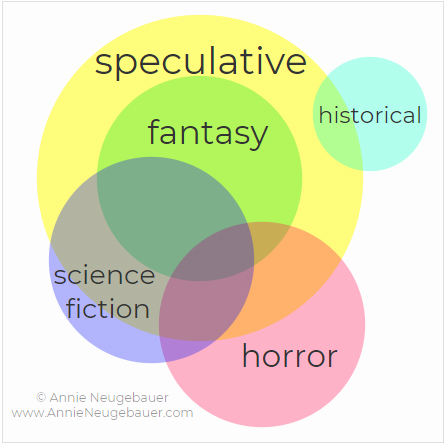
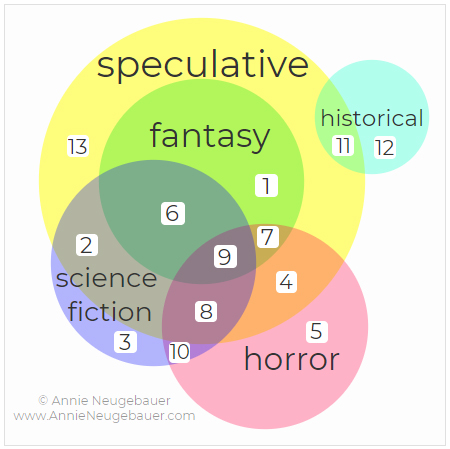
So what is speculative fiction? The fast answer: fantasy, science fiction, and horror. But as you can see by my hastily-drawn diagram [UPDATE: I finally made a nice diagram! Yay!], that oversimplification causes some serious problems. For one thing, both horror and science fiction can include works that aren’t actually “speculative.” (We’ll get to that in a minute.) For another, while those three are the dominant genres involved, they aren’t the only genres involved, and no one likes to be excluded.

That moves us to the need for a more accurate definition. The key here lies in the root word: speculate. Think of this in terms of “what if” and you’ll see it. So now you might ask, “But doesn’t that make all fiction speculative? Fiction, by definition, is untrue, so all of it involves some degree of speculation.” The difference is in what’s being speculated upon. Speculative fiction is fiction in which the author speculates upon the results of changing what’s real or possible, not how a character would react to a certain event, etc.

Therefore, the thing being speculated upon must be more elemental than character or plot. Speculative fiction is any fiction in which the “laws” of that world (explicit or implied) are different than ours. This is why the term “world-building” usually goes hand-in-hand with “speculative fiction.” If you’re changing our world or creating a new one, you’re going to have to do some work so the reader/viewer understands the new “rules.” Don’t let the word “world” throw you off, though. The defining line between fiction and speculative fiction is not so much scale as it is ‘what’s possible’ in reality. (Scale is more of a byproduct, and an optional one at that. Speculative fiction can be and often is small in scope–think a single character’s life vs. global battles.)

So dropping a bad guy into a nest full of alligators, while thrilling, isn’t “speculative” because it could really happen in our world. Dropping a bad guy into a nest full of mutant alligator-sharks is “speculative” because it isn’t possible in our world; the author must “speculate” on how that would go. (And I’m guessing the answer is “not well.”)

Another example: a movie in which two astronauts get lost in space isn’t speculative because it could really happen within the realm of our existing knowledge of the world, as terrifying as that may be. A movie in which a group of astronauts discover an alien life form is speculative because–according to our current knowledge–it couldn’t happen in real life, since we know of no other intelligent life forms. See the difference?

Speculative fiction takes our existing world and changes it by asking “What if…?” (What if monkeys could fly? What if zombies were real? What if the Nazis had won World War II? What if one man had x-ray vision?) This opens up the first definition — fantasy, science fiction, and horror — to include other genres as well, such as alternate history, weird tales, dystopian, apocalyptic, time travel, superhero, etc. It also excludes science fiction and horror that doesn’t speculate (i.e., horror without supernatural elements, or science fiction based on current technology).

Now that we have a good definition to go on, let’s take a more detailed look at my little diagram.

In area 1, we have the overwhelming component of speculative fiction: fantasy. By definition, all fantasy is speculative. This includes all subgenres, such as epic, soft, urban, and magical realism.

In area 2, we have another large component: science fiction. As I mentioned above, sci-fi is usually but not always speculative. (When it’s not it becomes section 3.) Speculative sci-fi often includes the sub genres of space travel and time travel.

In area 4, we have the third part of the main triumvirate: horror. Horror is frequently but not always speculative. Horror based on true events or without any supernatural elements falls outside the speculative ring (section 5). Speculative horror includes paranormal, creature, and weird tale to name a few.

Sections 6 through 10 are probably pretty self-explanatory. If you combine speculative sci-fi with speculative fantasy, for example, you might get superhero fiction. In all those little overlapping sections, it’s really a game of mix and match.

Section 12 is historical fiction without speculative elements, such as a fictionalized rendering of a real battle or a fictional character living in historically accurate settings. Section 11 is historical fiction with speculation thrown in, such as supernatural elements added, a shift in the real timeline (alternate history), etc.

Finally, there’s lucky section number 13, which holds all of those speculative stories that don’t fit neatly into fantasy, sci-fi, horror, or historical. These might include dystopian, weird tales, or surrealism.

As if that weren’t all complicated enough, if you shift some circles around you can build and blend your own genres. Expand “historical,” for example, so that it overlaps with “fantasy” and you’ve got historical fantasy (think vampires in the Victorian period or elves fighting in World War I). Throw in a healthy dose of fear and you might have historical horror.

The possibilities are really limitless, which is perhaps why so many people get confused by the term “speculative fiction.” If you find yourself getting lost, go back to the basics: could this world really exist according to our current knowledge of reality? If the answer is yes, it probably isn’t speculative. If the answer is no, it probably is speculative.

At this point you might be wondering, Does this mean that “speculative” changes over time? My answer is yes. As our knowledge and technology change, so does our interpretation of what’s “possible.” Technology in futuristic books written twenty years ago might not be speculative at all anymore. No to mention that individual beliefs can affect the definition, too. That’s how you get books about ghosts and aliens on the “nonfiction” shelf; some people believe these are already a part of our reality. Technology changes, knowledge grows, beliefs shift–and these are all things that inform our concept of “what’s possible.”

As you can see, the lines on all the circles I’ve drawn could be a little blurrier, but I hope I’ve shed some light on the general concept. As always I’m happy to answer questions below, or to hear your take on things!

Posted in Genres | Tagged | 96 Comments

The Line Between Public and Private

I’ve been thinking a lot lately about declaring one’s points of view in life. Everything from big things like religion, political stance, sexual orientation, etc., to small things like favorite authors, music tastes, and birthdays. Identifiers, basically, is what I’m talking about, and what we choose to call ourselves – and whether or not we choose to do so publicly.

I think there’s a fine line of choice in declaration. We can announce our labels because Facebook asks us to and that’s just what’s expected. Or we can announce our labels because we feel that it’s a way to be most honest about our authentic self. We can keep quiet because we’re ashamed or holding secrets, or we can choose not to declare because we simply don’t feel it’s anyone else’s business – don’t feel the need to justify our choices.

An example: I try really hard to stay out of politics in the digital sphere, even though I have strong opinions and a deep investment in current issues, for many different reasons. Those reasons vary from a weariness of pointless arguments that change no one’s mind to an awareness that I’m trying to build an author platform and that isolating potential readers isn’t wise.

So for these reasons and many, many more (it is always more complex than it sounds), I have kept silent. If someone asks me about my beliefs or anything like that, I answer them honestly if I feel comfortable doing so; I tell them it’s none of their business if it’s not. I don’t lie. I’ve never lied about such things, because I would find it personally injurious. On a deep, self-love level, I need to remain accepting of who I am.

Yet… I don’t declare. And so I wonder when not declaring becomes the same as keeping a secret. Especially in today’s world, where everyone is public about not just every opinion they have but every thought they have, one has to make a conscious effort not to reveal their stances. At times, to me, that effort begins to feel like secret-keeping. At times I feel the urge to tweet or blog about personal things. What if someone fills in their own blanks and gets them wrong? I hate the idea of being misinterpreted due to a need for privacy, but I also hate the idea of throwing away privacy for the sake of appearances.

Where’s the line?

I suspect the line is different for every person – and possibly different for each of us depending on our stage in life, mood, circumstances, etc. It’s not as if I haven’t blogged about personal things before. Blogging is inherently personal, to me, so it’s inevitable that I share some things. I blogged about my dad’s alcoholism and death because that was a “secret” that felt personally damaging to keep quiet about; speaking openly about shame subjects is a form of rejection – a way to refuse to buy in to what society tries to sell us. Not to mention that my only nonfiction writing (my poetry memoir Hope and Other Myths) is about this, so I’ve always been aware that this part of my life can’t remain private.

Other issues, like my battles with depression, my sweet husband, my hard-earned ‘life lessons,’ etc. have all come up organically, when I feel driven to talk about them – whether to share my experiences, hear advice or support, or whatever. Yet, somehow, there are large pieces of myself not represented online. And you know what? For now, I like it that way.

In a time when the very details of our meals, outfits, and moods are snapped and shared for friends, family, and strangers alike, I still value my right not to share. Not because I’m ashamed of my beliefs, stances, or decisions (I’m not), but because I believe there’s inherent value in allowing ourselves privacy. Just as sharing something can make it feel more real, keeping something personal can make it feel more authentic.

I love my blog, I love the internet, and I truly do love our modern culture of public life, but I don’t want to become the sum of my represented parts. So the line, for me, is constantly shifting near and far, but I appreciate the fact that there is a line, and I hope to keep it around.

Where’s the line for you?

Posted in Food for Thought | 28 Comments

Creation Credos: Fill in the Blanks

For a long time, I had a quote from one of my favorite authors taped above my computer screen:

Let me be wise in my creation, let me be fierce in its defense, let me be true to my message and my vision.” –Laurell K. Hamilton (source)

One day, as I was gazing at it while procrasti-thinking (like you do), I suddenly realized that, for me, two of the words were switched. I don’t really want to be fierce in defense of my art. My right to make it? Yes. The art itself? I’d rather let it go and keep creating than spend time defending what’s already done. That day, I printed out a new version:

Let me be fierce in my creation, let me be wise in its defense, let me be true to my message and my vision.

That felt more accurate to my personal tenets. For me, fierceness is more important than wisdom in the act of creation. Whereas it takes wisdom to know when and what to defend about my creation. So for a while I was satisfied with that.

But changing it made me realize that a credo such as this is really more of a personal choice than a blanket philosophy. Not only that, but each step or portion of creation deserves its own descriptor, its own goal. What words would I choose if I split my mantra into sections? What words would others choose? While in the process of thinking up my own, I went to Twitter (and then Facebook) with a simple fill-in-the-blank request:


I got 11 answers overall, a lovely mix of fun and thoughtful. Thank you so much to everyone who played!! I’d like to share them all before I share what I came up with for myself. (My comments are in italics; couldn’t resist!)

Your Answers:

Febe Moss ‏@TheFebeMoss

Dream with strangeness. Create with a tilted head. Review with focus. Submit with courage.

The titled head is my favorite here!

Daron Macke ‏@daronmacke

Dream with balls. Create with balls. Review with balls. Submit with balls! 🙂

For the record, women can and do all of the above despite not having the required anatomy. It’s all attitude!

Totes.

S.P. McConnell ‏@SP_McConnell

Dream with The Neverending Story. Create with Harold’s Crayon. Review with Nancy Drew’s eyeglass. Submit with Dumbledore’s Pensive.

Love the creativity here!

Laura Rueckert ‏@LauraRueckert

Dream with pillows. Create with pillows. Review with pillows. Submit with pillows.

I’m apparently a little tired. 😉

To be fair, pillows are really nice.

Aditya Thakur ‏@eddyfy_

Dream with soul. Create with heart. Review with brain. Submit with a smile.

Sometimes simple is the most effective!

Benjamin Inn ‏@BenjaminInn

Dream with EXPLOSIONS! Create with EXPLOSIONS! Review with EXPLOSIONS! Submit with EXPLOSIONS!

*makes explosion motion with hands* *adds sound effects*

Carie Juettner ‏@CarieJuettner

Dream with soul. Create with sweat. Review with heart. Submit with blood.

Create with sweat is my favorite here!

Alex Langley @RocketLlama

Dream with butts. Create with butts. Review with butts. Submit with butts.

Ah, butts. A classic reviewing tool.

June Weiss ‏@BijouxIce

Dream with abandon. Create with élan. Review with brutality. Submit with hope.

Hope is a good one. A required ingredient even?

Kalli Hale (via Facebook)

Dream with inspiration. Create with imagination. Review with irreverence. Submit with independence.

Irreverence is my middle name!

Russ Linton @Russ_Linton

Dream with Cthulhu. Create with Cthulhu. Review with Cthulhu. Submit with Cthulhu.

Ph’nglui mglw’nafh Cthulhu R’lyeh wgah’nagl fhtagn! (But shouldn’t it be submit to Cthulhu?)

My Answers:

Seeing these answers did help put my own thoughts into perspective. Of course, it’d be fun to come up with some silly ones too, but ^these guys really have that covered, and I was still looking for my real credo. Here’s what I’ve settled on:

Dream with abandon. Create with ferocity. Review with distance. Submit with quiet but infinite hope.

I’m not sure it’s worthy of being taped to my computer, but it was a nice exercise in examining my beliefs.

Missed the boat? Feel free to fill in the blanks yourself and share in the comments below:

Dream with _____. Create with _____. Review with _____. Submit with _____.

[Note 1: I’ll be on a writing retreat Sunday through Thursday, so I might not get to comments as quickly as I usually do. But please know I read and appreciate each one, and will get to them all when I get home, if not sooner!]

[Note 2: If you haven’t already, please do stop by my latest Twitter column at Writer Unboxed: “Should You Be On Twitter?” I’m helping undecided writers weight the pros and cons of joining Twitter.]

Posted in The Art | 15 Comments

Why Women in Horror Month Is Important

Did you know that February is Women in Horror Month (WiHM)? Unless you’re in the industry, the answer to that is probably no, although awareness and participation is spreading every year. The reaction people have when they hear this is often one of confusion, amusement, or scorn.

How many female horror writers could there be? they ask. More than you think, although many of them don’t like to call themselves that. Who cares about horror? Well, I do, for one. As do thousands of other horror fans and creators — not to mention consumers who don’t even realize some of their favorite works are horror. And the one that really indicates the state of things: Why should women get special treatment? Well, they shouldn’t. They should get equal treatment, but that’s not happening yet. I look forward to the day when WiHM isn’t necessary, and instead when female horror artists are duly recognized year-round.

Of course, being a woman in the horror industry, I have opinions on these things. In this post, I use the word “feminism,” and I feel the need to clarify that feminism is not about favoring women or hating men, nor about being a certain “type” of woman. Those are unfortunate misconceptions and stereotypes. Feminists are people who support equality between the sexes. Men can be feminists too. So why is it called feminism instead of humanism? Because right now, women are the ones not being treated as equals. It really is that simple. Do I call myself a feminist? You bet your ass I do.

My Women in Horror Manifesto

We need horror in books because fear, as one of the two most primal emotions, is worthy of artistic exploration. Indeed, it is an inescapable factor of the human condition.

We need horror in books because the more we run from things we fear, the more they lay chase. We need horror in books to face our fears head-on and defeat them.

We need feminism in books because novels about boyhood are considered noble and nostalgic while novels about girlhood are considered frivolous and shallow.

We need feminism in books because teenage girls are the most scoffed at demographic of our society, and because this attitude of derision is tossed about like it’s actually acceptable.

We need feminism in books because so many people still think “strong female character” means “one of the guys,” “kicks a lot of ass,” or “has no faults.”

We need feminism in books because “strong female characters” are still a topic of discussion rather than an actual wide-spread practice of writing women and writing them well.

We need feminism in horror because women can and do triumph over evil, conquer our fears, and save those who need saving.

We need feminism in books because real issues that affect real women are relegated to the genre “women’s fiction” while issues that affect men are labeled by genre irrespective of their sex.

We need feminism in horror because the same book, written by a man is called “horror,” written by a woman is called “gothic.”

We need feminism in books because, unfortunately, we still need things like Women in Horror Month for equally talented authors to get the same recognition as their male counterparts.

We need feminism in books because people are still afraid to call themselves feminists in public – even women. Our misogyny is so widespread that it’s internalized.

We need feminism in horror because women can be the bad guys too.

We need feminism in horror because women have their own unique fears that add value to the genre, both artistically and for entertainment value.

We need feminism in books because women writers are choosing male or gender-neutral pen names to avoid discrimination.

We need feminism in books because women writers are still facing discrimination in large and small ways on a daily basis – from book covers to genres to who does their reviews and what those reviews choose to comment on.

We need feminism in horror because women are more than a goal, a victim, or a prize.

We need feminism because we need women, and women need equality.

We need books because art reflects life, but art also changes life.

And more than anything, we need change.

~*~

Convinced? You can read more about Women in Horror Month and how to get involved on the official webpage, follow the conversation on Twitter at the hashtag #WiHM, and read guest posts on the topic all month long at the Horror Writers Association blog.

I know you all have something to add! Why do you think we need feminism and/or horror in books?

Posted in Books | Tagged | 32 Comments