Vampires and Zombies, part V: surviving the living dead

Originally posted on January 2, 2011 at 1:15 AM

Okay, we’ve talked about the sources of the myths, the popularization of the myths, and the distinctions and similarities between the myths. Now, the most important thing of all: how to survive if the myths become realities.

We’ll start with vampires. You’ve heard before that the best defense is a good offense, but in this case, the best defense is a good, well… defense. Ahead of time. A truly prepared person (which should, according to logic, include any and all boy scouts) doesn’t wait for vampires to make themselves known. Now is the perfect time to string your porch with garlic, place crosses (backed by faith, of course) on each door, scatter your yard with grains of rice, and catalog-order those silver bullets. And don’t forget the wooden stake! These items will not deter the truly determined dead, but much like a security system, it will likely send them roaming to your neighbor’s house instead – a much easier target.

If it’s personal, such as a relative or lover returned from the grave to seek vengeance or convert you to the immortal, they’re coming to your house no matter what you put up. In this case, you’ll be happy to hear that the ultimate stopping power belongs to you: the power of no. That’s right kiddos, just say no. To get into your house, a vampire must first get an invitation over the threshold. And unless you’re a bit of an idiot, you won’t give them that. Well, maybe that was a bit harsh. The emotional pull of seeing someone you thought was dead now standing on your doorstep could easily become overwhelming… but don’t give in. They are not who they were; they are now a soulless body seeking blood. Send them away. Stay inside. Call your local vampire executioner. And never ever EVER look a vampire in the eyes.

So if bloodsuckers are your pest of choice, you’re all set. Let’s move on to zombies. There are two basic schools of thought when it comes to surviving a zombie apocalypse: 1) fortify and stay put or 2) keep moving and don’t let them find you.

The thinking behind strategy one is to minimize chance of exposure to the zombies. If they can’t get to you, they can’t chomp you. The more you move, the more likely you are to meet other uninfected and be coerced to take them on – thus upping your general risk factor. Pros to this strategy include normality, a schedule, and the potential for something that resembles regular life. Cons to this strategy include trouble obtaining new resources and the possibility of being discovered and overpowered by the undead. If this is the strategy you decide to go with, the most important thing is to choose a good location for your hide-out. You need defenses such as high walls or natural barriers as well as ample food and fresh water supplies – preferably renewable resources. Have an exit strategy, don’t let in strangers, and never, ever relax your guard.

The theory behind strategy two is to escape the threat. Surrounded by zombies? Just leave. Okay, it’s not quite that simple. It is a risky choice in the immediate present, but if you travel light enough and move quickly enough, you may be able to reach an uninfected location. Pros to this strategy include new opportunities to obtain better resources, excitement, and the unlikelihood of being cornered. Cons include the possibility of running into brigands, becoming stranded, and physical and mental strain. If this is the strategy you decide to go with, it’s important to set some ground rules: are you allowing outsiders to tag along? Who is in charge of decisions? Don’t forget to ration provisions, weapons, and gear. Where are you going? It’s important that the whole group knows the plan, be it one or fifty. Know how much you’re willing to sacrifice, always thoroughly check new stop-sites, and build trust with your travel mates.

Hopefully the dead will never walk the earth, but if they do, you need to be prepared. Good luck, and Godspeed.

Be sure to check out the other posts in the series:

Vampires and Zombies, part I: introduction

Vampires and Zombies, part II: the popularization of vampires (in western culture)

Vampires and Zombies, part III: the popularization of zombies (in western culture)

Vampires and Zombies, part IV: compare and contrast

Share this:
Facebooktwitterredditpinterestlinkedintumblrmail
Posted in Vampires & Zombies | Tagged | 2 Comments

Vampires and Zombies, part IV: compare and contrast

Originally posted on December 22, 2010 at 5:50 PM

Let’s do a compare and contrast, children! Mmkay? Now, before you go pitching a fit because you know of a vampire that attacks violently or you’re a girl but you much prefer zombies, I’d like to say up front that there are exceptions to each of these “rules.” Every single one. So really, you don’t need to point that out (although if you do think of something that’s not on the lists, please let me know. I know I didn’t exhaust all of the possibilities!). This is for generalized concepting only, got it?

Similarities:

• undead
• humanoid
• supernatural
• prey on the living
• can be killed by burning or decapitating
• both come out of graves (at least originally)
• try to create more by attacking the living
• belong to horror genre
• spring from oral folklore
• considered soulless/evil

Differences:

• zombies can walk in sunlight; vampires can only come out at night
• zombies eventually decay; vampires are preserved immortally
• zombies are bloated/ruddy; vampires are unnaturally pale
• zombies eat flesh; vampires drink blood
• zombies shamble along slowly; vampires are preternaturally fast
• zombies come in hordes; vampires usually ride solo
• zombies are gross and scary; vampires (recently) are charismatic and sexy
• zombie attacks are chaotic and violent; vampire attacks are precise and purposeful
• zombies are just human; vampires can often shape shift into animals (bats, wolves, etc.)
• zombies are mindless; vampires are intelligent
• zombie fans are more likely to be male; vampire fans are more likely to be female
• the zombie myth is relatively concise; the vampire myth contains dozens of variations and details (silver bullets, crosses, holy water, garlic, no reflection in mirrors, can’t cross running water, have to count scattered rice grains, etc.)

Now, let’s discuss some of the more interesting ways these rules have been broken by various retellings, shall we? Let’s take the most basic assumption about vampires: they are “undead.” Not dead, because they move around, but not living, because they have no heartbeat or whatever. This seems pretty universal, right? Well, now there is this unique distinction cropping up between “living” and “undead” vampires. Kim Harrison’s Rachel Morgan series and Richelle Mead’s Vampire Academy series are two nice examples. In both, vampires can reproduce with other vampires to create “born” vampires (which are generally considered of a higher class in vampire society than “turned” vampires). These vampires are a species separate from humans, and when they die they will become “undead” vampires (which are often evil/soulless).

One of the most basic assumptions about zombies is that they are unintelligent. But if you consider the victims of the T-virus in the Resident Evil series zombies, some of them are actually hyper-intelligent. Likewise, the zombies in Simon Clark’s book Blood Crazy (which is one of my faves, btw) have a sort of collective intelligence, like ants, and can work together to serve a larger purpose in pursuit of their prey (who happen to be all of the world’s youth. That’s right; adult zombies vs. the kiddos, hells yeah!).

Vampires can’t walk in the sun, right? Wrong. How about Blade, also known as the Daywalker? Dracula could, despite popular belief, walk out in daylight. Damian can walk in daylight thanks to a special bond with Anita. Edward Cullen & co. sparkle but don’t combust when under the sun. And in the original myth, vampires could not only walk out in daylight, but were at their most powerful at high noon. To quote a completely random movie (Grease… did anyone else just get the random image of John Travolta with fangs?), “The rules are, there ain’t no rules.”

And of course, I’ve already mentioned the new trend of zombies getting faster and faster. 28 Days Later, Resident Evil, the Dawn of the Dead remake, Zombieland, and Land of the Dead are just a few examples.

Another assumption, about both, is that they belong in the horror genre. With the advent of vampire romances, I think many know that’s no longer true. And with movies like Zombieland and Shaun of the Dead, you’d have to do some serious convincing to make me believe they don’t belong in comedy.

And perhaps more interestingly than breaking the rules, is blurring the rules. When do zombies begin to act like vampires and vampires look like zombies? One wonderful example is the most recent remake of I am Legend starring Will Smith. I’ve written a blog about this before, but I’ll talk briefly about it again in reference to this series. In the book, the infected people are clearly vampires, so I went into the movie knowing the monsters would be vampires. But for people who didn’t know that, it’d be easy to see them as zombies. For one thing, their faces are all effed up, which is usually (in modern times) associated with zombies; vampires look like pale regular people. For another thing, zombies have come to be attached to viral apocalypse, even though this vampire book started that (see part III). So if someone didn’t know that history of the genre, it’d be easy to assume that a post-apocalyptic world with viral outbreak making infected humans hunt other humans was zombie-based. Moreover, we don’t really get to see the vampires attack anyone, do we? So the distinction between eating flesh and drinking blood is gone. All that’s really left is that the creatures can’t come out in the sunlight, and when it’s down to one thing, well, that could easily be attributed to a “quirk” in the zombie rules.

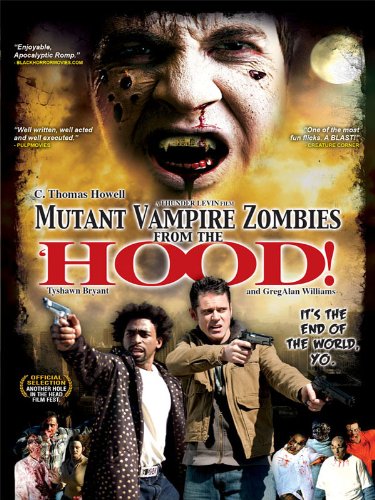
Other zombie-looking/acting vampires include those butt-ugly ones in 30 Days of Night and the equally butt-faced monster-vamps in From Dusk Till Dawn. Both vampire renditions reminded me more of zombies in their appearance (bloated, blistering, deformed), and both attacked with all of the chaos and rampage of fast-moving zombies. And some zombies that have sharp teeth (I can’t think of an example right now) sort of give off a fang-vibe that lends them to this blended vision of a vampire-zombie. And of course, there are always ridiculous purposeful combos, such as Mutant Vampire Zombies from the Hood (It’s the end of the world, yo!).

One thing I haven’t seen: zombies as a separate species, like vampires often are. Zombies can be reanimated, infected, contagious, and/or magic, but I’ve yet to see them as a Homo sapiens off-shoot. That’d be interesting.

Up next: whatever strikes my fancy. Any requests?

Be sure to check out the other posts in the series:

Vampires and Zombies, part I: introduction

Vampires and Zombies, part II: the popularization of vampires (in western culture)

Vampires and Zombies, part III: the popularization of zombies (in western culture)

Vampires and Zombies, part V: surviving the living dead

Share this:
Facebooktwitterredditpinterestlinkedintumblrmail
Posted in Vampires & Zombies | Tagged , | 4 Comments

Vampires and Zombies, part III: the popularization of zombies (in western culture)

Originally posted on December 20, 2010 at 8:16 PM

Whereas the popularization of vampires timeline relied predominately on literature, the timeline for zombies will consist mainly of filmography. This is for the practical reason that not many famous zombie novels exist, especially before 1998 (don’t believe me? check out this Wikipedia chart … not that I think Wikipedia is a complete resource, but still, it gives an indication). This is because, in my opinion, zombies are primarily significant for their visual impact, much more so than their vampire counterparts. Although, to be fair, the inspiration for those movies, when you boil it down, almost always comes from literature (or other movies themselves inspired by literature), so I did include the biggies.

• 2150-2000 BC The Epic of Gilgamesh, epic poem
• 1818 Frankenstein; or, The Modern Prometheus, novel by Mary Shelley
• 1920 The Cabinet of Dr. Caligari, silent movie by Robert Wiene
• 1921 “Herbert West—Reanimator,” short story by H. P. Lovecraft
• 1929 The Magic Island, novel by W.B. Seabrook
• 1932 White Zombie, movie by Victor Halperin
• 1936 Things to Come, movie based on the novel by H.G. Wells
• 1954 I am Legend, novel by Richard Matheson
• 1968 Night of the Living Dead, movie by George A. Romero.
• 1981 Hell of the Living Dead movie by Bruno Mattei
• 1983 Thriller, music video by Michael Jackson
• 1985 Return of the Living Dead, movie by Dan O’Bannon
• 1985 Re-Animator, movie loosely based on the Lovecraft story
• 1988 The Serpent and the Rainbow, movie by Wes Craven
• 1993 Army of Darkness, movie by Sam Raimi
• 2002, 2004, 2007 and 2010 Resident Evil series, movies based on the video game by Shinji Mikami
• 2002, 2007 28 Days Later and 28 Weeks Later, movies by Danny Boyle and Juan Carlos Fresnadillo
• 2003 House of the Dead, movie by Uwe Boll
• 2004 Dawn of the Dead, movie remake by Zack Snyder
• 2004 Shaun of the Dead, movie by Edgar Wright
• 2009 Zombieland, movie by Ruben Fleischer

Before written history, stories of zombies originated in the West African spiritual belief system of Vodun, which told of people being controlled like puppets by a powerful spiritualist. I would argue, however, that similar myths existed in many cultures, as evidenced by The Epic of Gilgamesh. This epic poem is arguably the oldest written story on Earth. Can’t say I’ve read it, but apparently it mentions the undead hungry for human blood or flesh.

Most people have heard of Frankenstein, in which a mad scientist pieces together a “monster” from scrap human body parts. The only work I found worth mentioning from the 19th century, Frankenstein’s monster is not yet what we would think of as a zombie, although he does share some significant traits.

Zombies were a small but present icon in our culture from the 1920’s through the 1930’s. Stories, movies, and novels all presented zombies in an array of different lights – including White Zombie which ironically starred Bela Lugosi, the most famous Dracula actor to ever take the screen. Some people argue that the 1936 film Things to Come anticipated the modern “zombie apocalypse” trend, but the infected in that movie aren’t quite zombies, not to mention that this argument becomes somewhat irrelevant when you look at the next fiction piece on the list in 1954:

As I hinted in part II, perhaps the most ironic (and hard to swallow, for die-hard zombie fans) aspect of zombie culture is that what it is today was most heavily influenced by a zombie novel – namely, I am Legend by Richard Matheson. Say “zombie” to any person under 30 today, and most likely they picture the post-apocalyptic, viral, running-zombie world of 28 Days Later before they picture the slow-moving, black-and-white, graveyard churning world of zombie-yore. Why? Because the most game-changing and iconic zombie media of all time came out in 1968 with George A. Romero’s Night of the Living Dead, and that movie was based admittedly and blatantly on the apocalyptic setting of Matheson’s vampire novel.

Would Things to Come have eventually influenced future zombie movies in the same viral apocalypse direction? Possibly. But it didn’t, because Romero did first and more thoroughly, and he got the concept straight out of one of the most overlooked vampire novels ever written. We’re hard-pressed today to find any zombie movies based on graveyard-raising, voodoo-caused corpses. Now it’s all about the disease.

As if Romero wasn’t enough, Michael Jackson took zombies to the top of the “cool” list in 1983 when he put out his music video for “Thriller.” Dancing dead, anyone?

Worth mentioning: You know that image you have of a zombie going “Brains!” and walking toward you with uplifted arms? That comes from Return of the Living Dead. And yes, it was supposed to be funny.

Wes Craven’s late 80’s film The Serpent and the Rainbow was based on a non-fiction book by Wade Davis. It attempted to reestablish the original link between zombies and Vodoo.

Now comes one of the most interesting detail-changes in the genre, in my opinion. In 2002 the first installments in both the Resident Evil and 28 Days Later series came out. What did they have in common that had never been done before? The zombies ran. Fast. Gone are the days of slow-moving corpses that are scary for their persistence and sheer numbers; these zombies can and did chase you, and fast-moving camera work enhanced the effect. Why the change? Not sure. People disagree over which is scarier, and I can see both sides of the argument. I’ll talk more about this change in part IV.

And finally, zombies have reached their stride (sorry). Zombies appear in movies, tv shows, books, comic books, video games, and even wedding themes. What do you do when something has become this popular? Well, you make fun of it, a la Shaun of the Dead and Zombieland. It’s a beautiful thing, and zombies are still on the rise. Will they burn out? Do they have the staying power of vampires (who, according to some Twilight-sick spectators, are so cool they reached that not-cool-anymore stage)? Let’s watch and see.

Coming up next: the distinctions between vampires and zombies. What makes which creature, or “species,” which, and do the lines ever become blurry?

Be sure to check out the other posts in the series:

Vampires and Zombies, part I: introduction

Vampires and Zombies, part II: the popularization of vampires (in western culture)

Vampires and Zombies, part IV: compare and contrast

Vampires and Zombies, part V: surviving the living dead
Share this:
Facebooktwitterredditpinterestlinkedintumblrmail
Posted in Vampires & Zombies | Tagged | 2 Comments

Christmas Mice

Originally posted on December 13, 2010 at 2:45 PM

When it comes to Christmas animals, there’s one clear-cut winner in my book: Christmas mice.

The deciding factors of what makes an animal “Christmasy” could be up for grabs, so I’ll share my list: reindeer, donkeys, lambs, owls, swans, polar bears, penguins, kittens, puppies, mice, small birds (doves, cardinals, etc.), and woodland creatures (squirrels, hedgehogs, foxes, moose).

Donkeys and lambs count because of the nativity. Polar bears and penguins count because of Coke commercials. Reindeer ‘cause of Santa. Owls and woodland creatures because of winter décor, birds because of ornaments, kittens and puppies because of how cute they look as presents in stockings or with a big bow, and mice because of “The Night Before Christmas.” Frogs don’t count because they have no tie-in. Same with Kangaroos.

Some of you might be wondering why my personal favorite would be mice instead of kittens. The answer is simple: kittens are a year-round joy for me. Mice, although always cute, are simply cuter and more prominent during Christmas. Same with owls and penguins: I love them, but they’re almost always in the spotlight. Mice get one time a year to be fully recognized for all of their adorable squee-worthiness, and Christmas is it.

There’s something very sweet and endearing to me about the idea of a little mouse celebrating Christmas. “’Twas the night before Christmas, when all through the house, not a creature was stirring, not even a mouse.” All snug in his lil mouse bed. Aww.

Mice are unassuming. They don’t ask for much. They don’t want attention or presents or even to be invited to the party. They just want to hang around and nibble a few of the crumbs left unwanted. They’re adorable with their oversized ears and their wiggly little noses. Dark, expressive eyes and whiskers just like a kitty. Put them in a nightgown holding an old-fashioned candlestick or wrapped up in a scarf and overcoat, and the cuteness meter suddenly bursts. They’re just that sweet. Bottom line: mice are always nice, but Christmas mice are twice as nice.

Here’s hoping this Christmas (or winter, or whatever) finds you with several nice little mice tucked away in quiet corners.

Share this:
Facebooktwitterredditpinterestlinkedintumblrmail
Posted in Just for Fun | Tagged , | Leave a comment

To Overcome

Originally posted on December 10, 2010 at 7:30 PM

This past Sunday, I went with Mom-in-Law to watch Hub-a-Dub run the White Rock Marathon in Dallas. Now, I’ve never had much interest in running. As I tell Kyle, I pretty much only run if I’m being chased. But what surprised me the most about being at the event was how emotional it made me. I almost cried about a dozen times. Seriously.

Like so many women are (and some men, too, although studies show that women are generally more so inclined than men), I’ve always been a very empathetic person. I’m one of those people who tends to make the facial expression of the person I’m talking to. It’s not that I’m making fun of them; it’s that I’m concentrating so hard on what they’re saying and trying to understand where they’re coming for that I end up mimicking them. It’s the same reason I cry in silly TV shows and hate it when my loved ones feel sad: I feel it too. Always have.

It was the same at the marathon. As we were hanging out around the sixteen mile marker waiting for Kyle to run by, I couldn’t help but look at the faces of the strangers running. Up until that moment, honestly, I’d dismissed them all as overzealous lunatics (in a friendly way). But seeing the determination, the exhaustion, the heartbreak, and the triumph in their faces as they trudged by – some of them barely walking – I couldn’t help but feel it all too. It was like I suddenly understood.


Now, everyone who runs marathons runs for different reasons. Some people do it to get themselves into shape, some people do it to prove something, some people do it as a lifestyle, some people run to support or promote a cause, and some people (as crazy as it seems) just do it for fun. But the type of person I really connected with were the people who looked like they were doing it to create and overcome an obstacle in their life.

At first, it seemed crazy to me. But then I realized that not all people have been through what I’ve been through, and not all people have the “life” goals I have. I do remember a time when I was about 12-15 that I longed for something dramatic to happen to test me as a person. I wanted life to throw something at me so I could prove myself. It might sound silly, but it wasn’t silly. It was a natural desire to grow. I think, just maybe, that some people who run marathons run because either 1) their life is too ‘easy’ and ‘happy’ to challenge their strength, or 2) they have such horrible things going on that they can’t overcome them, and they need something hard but possible to overcome to feel better. Those both make perfect sense to me, and in spite of the insanity and risks of running a marathon (especially if you aren’t smart about it), I approve.

For people who battle depression – and I guess anyone, really – it’s important to occasionally conquer a goal to gain a sense of achievement. Now I personally have such lofty full-time goals and a difficult enough life that I would never dream of using something as strenuous as a marathon to fulfill that need. (I like easy things, like getting to the top of a climbing wall or baking a new recipe.) But for other people, I could see how it might really work. So much so that I teared up as they ran by, and I couldn’t help but cheer for them to accomplish their goal. Run on, you lunatics, run on. (Not you, Hub-a-Dub. Please stop.)

Share this:
Facebooktwitterredditpinterestlinkedintumblrmail
Posted in Goals | Tagged , | Leave a comment