Vampires and Zombies, part IV: compare and contrast

Originally posted on December 22, 2010 at 5:50 PM

Let’s do a compare and contrast, children! Mmkay? Now, before you go pitching a fit because you know of a vampire that attacks violently or you’re a girl but you much prefer zombies, I’d like to say up front that there are exceptions to each of these “rules.” Every single one. So really, you don’t need to point that out (although if you do think of something that’s not on the lists, please let me know. I know I didn’t exhaust all of the possibilities!). This is for generalized concepting only, got it?

Similarities:

• undead
• humanoid
• supernatural
• prey on the living
• can be killed by burning or decapitating
• both come out of graves (at least originally)
• try to create more by attacking the living
• belong to horror genre
• spring from oral folklore
• considered soulless/evil

Differences:

• zombies can walk in sunlight; vampires can only come out at night
• zombies eventually decay; vampires are preserved immortally
• zombies are bloated/ruddy; vampires are unnaturally pale
• zombies eat flesh; vampires drink blood
• zombies shamble along slowly; vampires are preternaturally fast
• zombies come in hordes; vampires usually ride solo
• zombies are gross and scary; vampires (recently) are charismatic and sexy
• zombie attacks are chaotic and violent; vampire attacks are precise and purposeful
• zombies are just human; vampires can often shape shift into animals (bats, wolves, etc.)
• zombies are mindless; vampires are intelligent
• zombie fans are more likely to be male; vampire fans are more likely to be female
• the zombie myth is relatively concise; the vampire myth contains dozens of variations and details (silver bullets, crosses, holy water, garlic, no reflection in mirrors, can’t cross running water, have to count scattered rice grains, etc.)

Now, let’s discuss some of the more interesting ways these rules have been broken by various retellings, shall we? Let’s take the most basic assumption about vampires: they are “undead.” Not dead, because they move around, but not living, because they have no heartbeat or whatever. This seems pretty universal, right? Well, now there is this unique distinction cropping up between “living” and “undead” vampires. Kim Harrison’s Rachel Morgan series and Richelle Mead’s Vampire Academy series are two nice examples. In both, vampires can reproduce with other vampires to create “born” vampires (which are generally considered of a higher class in vampire society than “turned” vampires). These vampires are a species separate from humans, and when they die they will become “undead” vampires (which are often evil/soulless).

One of the most basic assumptions about zombies is that they are unintelligent. But if you consider the victims of the T-virus in the Resident Evil series zombies, some of them are actually hyper-intelligent. Likewise, the zombies in Simon Clark’s book Blood Crazy (which is one of my faves, btw) have a sort of collective intelligence, like ants, and can work together to serve a larger purpose in pursuit of their prey (who happen to be all of the world’s youth. That’s right; adult zombies vs. the kiddos, hells yeah!).

Vampires can’t walk in the sun, right? Wrong. How about Blade, also known as the Daywalker? Dracula could, despite popular belief, walk out in daylight. Damian can walk in daylight thanks to a special bond with Anita. Edward Cullen & co. sparkle but don’t combust when under the sun. And in the original myth, vampires could not only walk out in daylight, but were at their most powerful at high noon. To quote a completely random movie (Grease… did anyone else just get the random image of John Travolta with fangs?), “The rules are, there ain’t no rules.”

And of course, I’ve already mentioned the new trend of zombies getting faster and faster. 28 Days Later, Resident Evil, the Dawn of the Dead remake, Zombieland, and Land of the Dead are just a few examples.

Another assumption, about both, is that they belong in the horror genre. With the advent of vampire romances, I think many know that’s no longer true. And with movies like Zombieland and Shaun of the Dead, you’d have to do some serious convincing to make me believe they don’t belong in comedy.

And perhaps more interestingly than breaking the rules, is blurring the rules. When do zombies begin to act like vampires and vampires look like zombies? One wonderful example is the most recent remake of I am Legend starring Will Smith. I’ve written a blog about this before, but I’ll talk briefly about it again in reference to this series. In the book, the infected people are clearly vampires, so I went into the movie knowing the monsters would be vampires. But for people who didn’t know that, it’d be easy to see them as zombies. For one thing, their faces are all effed up, which is usually (in modern times) associated with zombies; vampires look like pale regular people. For another thing, zombies have come to be attached to viral apocalypse, even though this vampire book started that (see part III). So if someone didn’t know that history of the genre, it’d be easy to assume that a post-apocalyptic world with viral outbreak making infected humans hunt other humans was zombie-based. Moreover, we don’t really get to see the vampires attack anyone, do we? So the distinction between eating flesh and drinking blood is gone. All that’s really left is that the creatures can’t come out in the sunlight, and when it’s down to one thing, well, that could easily be attributed to a “quirk” in the zombie rules.

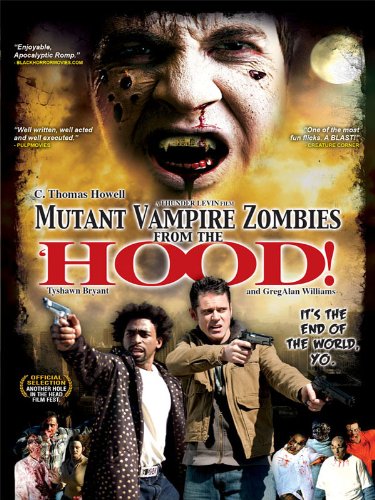
Other zombie-looking/acting vampires include those butt-ugly ones in 30 Days of Night and the equally butt-faced monster-vamps in From Dusk Till Dawn. Both vampire renditions reminded me more of zombies in their appearance (bloated, blistering, deformed), and both attacked with all of the chaos and rampage of fast-moving zombies. And some zombies that have sharp teeth (I can’t think of an example right now) sort of give off a fang-vibe that lends them to this blended vision of a vampire-zombie. And of course, there are always ridiculous purposeful combos, such as Mutant Vampire Zombies from the Hood (It’s the end of the world, yo!).

One thing I haven’t seen: zombies as a separate species, like vampires often are. Zombies can be reanimated, infected, contagious, and/or magic, but I’ve yet to see them as a Homo sapiens off-shoot. That’d be interesting.

Up next: whatever strikes my fancy. Any requests?

Be sure to check out the other posts in the series:

Vampires and Zombies, part I: introduction

Vampires and Zombies, part II: the popularization of vampires (in western culture)

Vampires and Zombies, part III: the popularization of zombies (in western culture)
Vampires and Zombies, part V: surviving the living dead

Posted in Vampires & Zombies | Tagged , | 4 Comments

Vampires and Zombies, part III: the popularization of zombies (in western culture)

Originally posted on December 20, 2010 at 8:16 PM

Whereas the popularization of vampires timeline relied predominately on literature, the timeline for zombies will consist mainly of filmography. This is for the practical reason that not many famous zombie novels exist, especially before 1998 (don’t believe me? check out this Wikipedia chart … not that I think Wikipedia is a complete resource, but still, it gives an indication). This is because, in my opinion, zombies are primarily significant for their visual impact, much more so than their vampire counterparts. Although, to be fair, the inspiration for those movies, when you boil it down, almost always comes from literature (or other movies themselves inspired by literature), so I did include the biggies.

• 2150-2000 BC The Epic of Gilgamesh, epic poem
• 1818 Frankenstein; or, The Modern Prometheus, novel by Mary Shelley
• 1920 The Cabinet of Dr. Caligari, silent movie by Robert Wiene
• 1921 “Herbert West—Reanimator,” short story by H. P. Lovecraft
• 1929 The Magic Island, novel by W.B. Seabrook
• 1932 White Zombie, movie by Victor Halperin
• 1936 Things to Come, movie based on the novel by H.G. Wells
• 1954 I am Legend, novel by Richard Matheson
• 1968 Night of the Living Dead, movie by George A. Romero.
• 1981 Hell of the Living Dead movie by Bruno Mattei
• 1983 Thriller, music video by Michael Jackson
• 1985 Return of the Living Dead, movie by Dan O’Bannon
• 1985 Re-Animator, movie loosely based on the Lovecraft story
• 1988 The Serpent and the Rainbow, movie by Wes Craven
• 1993 Army of Darkness, movie by Sam Raimi
• 2002, 2004, 2007 and 2010 Resident Evil series, movies based on the video game by Shinji Mikami
• 2002, 2007 28 Days Later and 28 Weeks Later, movies by Danny Boyle and Juan Carlos Fresnadillo
• 2003 House of the Dead, movie by Uwe Boll
• 2004 Dawn of the Dead, movie remake by Zack Snyder
• 2004 Shaun of the Dead, movie by Edgar Wright
• 2009 Zombieland, movie by Ruben Fleischer

Before written history, stories of zombies originated in the West African spiritual belief system of Vodun, which told of people being controlled like puppets by a powerful spiritualist. I would argue, however, that similar myths existed in many cultures, as evidenced by The Epic of Gilgamesh. This epic poem is arguably the oldest written story on Earth. Can’t say I’ve read it, but apparently it mentions the undead hungry for human blood or flesh.

Most people have heard of Frankenstein, in which a mad scientist pieces together a “monster” from scrap human body parts. The only work I found worth mentioning from the 19th century, Frankenstein’s monster is not yet what we would think of as a zombie, although he does share some significant traits.

Zombies were a small but present icon in our culture from the 1920’s through the 1930’s. Stories, movies, and novels all presented zombies in an array of different lights – including White Zombie which ironically starred Bela Lugosi, the most famous Dracula actor to ever take the screen. Some people argue that the 1936 film Things to Come anticipated the modern “zombie apocalypse” trend, but the infected in that movie aren’t quite zombies, not to mention that this argument becomes somewhat irrelevant when you look at the next fiction piece on the list in 1954:

As I hinted in part II, perhaps the most ironic (and hard to swallow, for die-hard zombie fans) aspect of zombie culture is that what it is today was most heavily influenced by a zombie novel – namely, I am Legend by Richard Matheson. Say “zombie” to any person under 30 today, and most likely they picture the post-apocalyptic, viral, running-zombie world of 28 Days Later before they picture the slow-moving, black-and-white, graveyard churning world of zombie-yore. Why? Because the most game-changing and iconic zombie media of all time came out in 1968 with George A. Romero’s Night of the Living Dead, and that movie was based admittedly and blatantly on the apocalyptic setting of Matheson’s vampire novel.

Would Things to Come have eventually influenced future zombie movies in the same viral apocalypse direction? Possibly. But it didn’t, because Romero did first and more thoroughly, and he got the concept straight out of one of the most overlooked vampire novels ever written. We’re hard-pressed today to find any zombie movies based on graveyard-raising, voodoo-caused corpses. Now it’s all about the disease.

As if Romero wasn’t enough, Michael Jackson took zombies to the top of the “cool” list in 1983 when he put out his music video for “Thriller.” Dancing dead, anyone?

Worth mentioning: You know that image you have of a zombie going “Brains!” and walking toward you with uplifted arms? That comes from Return of the Living Dead. And yes, it was supposed to be funny.

Wes Craven’s late 80’s film The Serpent and the Rainbow was based on a non-fiction book by Wade Davis. It attempted to reestablish the original link between zombies and Vodoo.

Now comes one of the most interesting detail-changes in the genre, in my opinion. In 2002 the first installments in both the Resident Evil and 28 Days Later series came out. What did they have in common that had never been done before? The zombies ran. Fast. Gone are the days of slow-moving corpses that are scary for their persistence and sheer numbers; these zombies can and did chase you, and fast-moving camera work enhanced the effect. Why the change? Not sure. People disagree over which is scarier, and I can see both sides of the argument. I’ll talk more about this change in part IV.

And finally, zombies have reached their stride (sorry). Zombies appear in movies, tv shows, books, comic books, video games, and even wedding themes. What do you do when something has become this popular? Well, you make fun of it, a la Shaun of the Dead and Zombieland. It’s a beautiful thing, and zombies are still on the rise. Will they burn out? Do they have the staying power of vampires (who, according to some Twilight-sick spectators, are so cool they reached that not-cool-anymore stage)? Let’s watch and see.

Coming up next: the distinctions between vampires and zombies. What makes which creature, or “species,” which, and do the lines ever become blurry?

Be sure to check out the other posts in the series:

Vampires and Zombies, part I: introduction

Vampires and Zombies, part II: the popularization of vampires (in western culture)

Vampires and Zombies, part IV: compare and contrast

Vampires and Zombies, part V: surviving the living dead

Posted in Vampires & Zombies | Tagged | 2 Comments

Vampires and Zombies, part II: the popularization of vampires (in western culture)

Originally posted on December 17, 2010 at 3:15 PM

When I say “vampire,” you most likely think Twilight, Dracula, and maybe Anne Rice. But the truth is, there are dozens more authors that have made vampires what they are today. Let’s make it simple. I’ve compiled a timeline of almost 300 years of what I see to be the most genre-changing (and genre-creating) literature about vampires. (And yes, I have read almost all of these.) I’ll explain specifics below.

• 1748 “The Vampire,” poem by Heinrich August Ossenfelder
• 1773 “Die Braut von Corinth” (“The Bride of Corinth”;), poem by Johann Wolfgang von Goethe
• 1800 “Christabel,” unfinished poem by Samuel Taylor Coleridge
• 1813 “The Giaour,” poem by Lord Byron
• 1819 “The Vampyre,” short story originally attributed to Lord Byron but actually by John Polidori
• 1845 to 1847 Varney the Vampire, vampire mini-series originally published in the Penny Dreadfuls., attributed to James Malcolm Rymer or Thomas Preskett Prest
• 1847 Wuthering Heights, novel by Emily Bronte
• 1872 Carmilla, novella by Joseph Thomas Sheridan Le Fanu
• 1897 Dracula, famous novel by Bram Stoker
• 1954 I am Legend, novel by Richard Matheson
• 1976 The Vampire Chronicles series (Interview with the Vampire) by Anne Rice
• 1978 Hôtel Transylvania novel by Chelsea Quinn Yarbro
• 1993 Anita Blake series (Guilty Pleasures, The Laughing Corpse) by Laurell K. Hamilton’s
• 2001 Sookie Stackhouse/Southern Vampire series (Dead Until Dark) by Charlaine Harris
• 2004 Rachel Morgan series (Dead Witch Walking) by Kim Harrison
• 2005 Twilight series by Stephenie Meyer

As you can see, vampire frenzy started up in western Europe in the mid-1700’s. Myths and superstitions from other cultures suddenly took the forefront in places like England and Germany, and believe it or not, there was a real historic vampire-crisis – not unlike the witch trials around 1600. People became so paranoid they actually dug up dead family members and staked them. Crazy much?

Anywho, this fear played well into creative minds, and it wasn’t long before poets and short-storyists were churning out the frights. Lord Byron, a popular and flamboyant figure of the early 1800’s, wrote a poem that mentioned vampires, which was quickly capitalized upon by his physician with a short story titled, “The Vampyre.” Byron was something like a modern-day movie star, and his paparazzi instantly recognized him as the central character in Polidori’s work. This was the beginning of vampires being sauve and sexy rather than disgusting and fearsome. In fact, many scholars use the term “Byronesque” to describe the archetype of the charming vampire (or any dark, brooding hero with destructive tendencies, a la Jean-Claude or Edward Cullen).

Books took longer to spread, back then. As the popularity of “Byron’s” story grew, other artists once again capitalized on the opportunity: The Penny Dreadfuls – sort of a cheap periodical with slasher stories – began to put out a mini-series about vampires, and although not of the best quality (actually, they’re frightfully bad), they sold like gold. It is safe to say that “vampire” was a well-known term in England by 1845. Very well known.

Some of you may have noticed that I included Emily Bronte’s Wuthering Heights in the timeline. Although not a traditional vampire story, I would argue that it is indeed about vampires, and written by a woman who knew exactly what she was doing. It’s too in-depth of an argument to post here, but I also believe that Ms. Bronte most likely influenced the infamous Bram Stoker some fifty years later.

But alas, it is Stoker who remains cemented most permanently into this history of vampires. Like it or not, Dracula was the first novel-length work published in English that had a clearly-stated vampire character. It was not hugely successful at first, although very well-received. Critics praised it and readers loved it, but it did not gain the notoriety it has today until movie versions started coming out in the late 1900’s. And important to note here: the vampire, although a count in a gloomy castle, was the villain.

Vampires didn’t make waves again until Richard Matheson’s I am Legend came out in 1954. This is a hugely, hugely important book. It was the first popular piece to turn vampirism into a scientific phenomenon not based on magic. In Matheson’s novella, vampirism was a bacteria that spread as a disease. It was also one of the first disease-based apocalypse novels, and interestingly enough, it shaped the zombie genre significantly more than the vampire one… but I’ll talk more about that in the popularization of zombies.

Perhaps the reason the apocalypse concept didn’t take hold with vampires was due to the popularity of Anne Rice’s series just twenty years later. She went back more toward a Byronesque character, and her most notable contribution to the genre: the vampire was the protagonist. In Interview with a Vampire, Rice explores the deeper themes of vampirism through her vampires Louis & Lestat: loneliness, morality, mortality, humanity, etc. This series is no easy read; Rice takes us through history and philosophy and the darker side of human nature.

In the late 70’s and early 80’s, several individual vampire novels came out, but I find Hôtel Transylvania by Chelsea Quinn Yarbro worth mentioning specifically for one reason: it was a romance. Anne Rice might have had some romantic themes going, but Yarbro was the first to popularize the full-on vampire/human love story. You may thank her later.

Vampires remained in popular culture, in the background for the most part, until the 90’s rolled around with the awesomely fabulous Laurell K. Hamilton. Her Anita Blake series changed not just the vampire genre, but the shelves of bookstores to this day. She was the first, most successful author to put out such a genre-bending series (horror, fantasy, sci-fi, mystery, romance… what is it?) that readers couldn’t get enough of. She got rejected for her first novel in the series for YEARS before someone took a chance on her. And aren’t they happy now, counting their money in their mansion on the top of a mountain somewhere?

From then on, publishers started suddenly requesting “Hamilton-esque” vampire series, with werewolves, fairies, and monsters thrown in. In my opinion, this made possible the Sookie Stackhouses, Rachel Morgans, and yes, even the Bella Swans of today’s literary landscape.

Be sure to check out the other posts in the series:

Vampires and Zombies, part I: introduction

Vampires and Zombies, part III: the popularization of zombies (in western culture)

Vampires and Zombies, part IV: compare and contrast

Vampires and Zombies, part V: surviving the living dead

Posted in Vampires & Zombies | Tagged | 4 Comments

Support Local Poetry

Originally posted on November 22, 2010 at 2:20 PM

The Denton Poets’ Assembly just celebrated 5 years! Yay! Happy anniversary, DPA!

I must say, I’m not one for mushy stuff. But when I moved from Austin to Denton to live with hub-a-dub, I hated it. I love hub-a-dub, but I hated Denton with a passion. When people would say conversational things like, “So, how are you liking it here so far?” I felt like reaching out and strangling them with my bare hands as I stomped on their feet and spit on the ground shouting, “I HATE IT HERE, DAMN IT. CURSES TO YOU ALL!” Okay, so maybe that’s a bit much, but I would shrug and say, “I’m still getting used to it.” Truth was, I didn’t think I’d ever be ‘used to it.’

That is, until I stumbled upon the Denton Poets’ Assembly. From the first time I went three years ago, I knew it was a group I wanted to be a part of. No matter that I was about 35 years younger than the average age or that my poetry was about vastly different things than most, they welcomed me with true enthusiasm and acceptance. It was going to that meeting each month that first made me feel like there was something in this town for me – that I might someday want to call this home.

Not only that, but it was DPA who encouraged me to start submitting my work to contests and publications. It was J. Paul Holcomb, the group’s mentor, who inspired me to start learning and writing in traditional poetic forms in any real way. It was a few special ladies who invited me into their small critique group and encouraged my confidence and pursuit of this passion I have. I count all of the members of DPA among my friends, and several of them among my closest. Thank you, Denton Poets’ Assembly, for all you’ve done for me. How ever did I get so lucky?

So it’s with true enthusiasm that I tell you all now about our newest fundraiser, which is easier and cooler than any fundraiser I’ve ever heard of. You shop on Amazon.com, yes? You plan on buying Christmas gifts there this year, yes? Well, perhaps you could add one extra click to that process. If you first go through our website and click to Amazon that way (just click the banner at the top of the page), between 4 and 15% of what you buy during that shopping trip will go to our organization. That money supports cool things like the Merging Visions Exhibit we participate in each year. Gift cards, books, home wares, DVDs, etc. all count, and once you click on our link it’s just like shopping on Amazon regularly, no extra cost to you. That’s it, seriously – no extra work. One click. We’d be much obliged.

This blog has been long enough, so I’ll bid you all farewell, good poetry, and happy shopping. (Tell your friends!)

Posted in Poetry | Tagged | Leave a comment

Vampires and Zombies, part I: introduction

Originally posted on December 15, 2010 at 4:25 PM

Vampires and zombies! Ah, the age-old debate.

I’m going to go ahead and say now that I’m not an expert… more like a well-educated fanatic. I know more about vampires than zombies, and won’t try to hide that I favor vampires over zombies – although I absolutely adore both. I’ve written college essays over vampires. I’ve done in depth research about both, from pre-written folkloric history of the myths to contemporary literature and movies. So I can’t pretend to know it all, but I will say that I know a lot. In fact, I think I know too much to be contained in one blog. Instead, I’ll make a little mini-series about it. How does that sound? (Before you scaredy-cats go running, trust me when I say that even if you don’t enjoy watching/reading zombie/vampire literature and movies, there is still a lot to learn from the myths and what they’re saying.)

To start with, let’s talk about the fact that the distinctions between vampires, zombies, ghosts, ghouls, and revenants weren’t always so clear-cut. In general, in the times of spoken legend and myth, there were “monsters.” Any and all living come back as the dead were terrifying, believed to be real, and sort of all the same. Ghosts, vampires, and zombies all tended to come back for loved ones to torture them and perhaps take a sip or a nibble. In fact, vampires used to not only drink blood, but eat flesh. What differentiates that from a zombie? Well, before the pop culture concept of zombies being virus-caused, which I’ll get into later: nothing.

Now, ghosts didn’t necessarily have corporeal bodies, but they could be seen to have bodies, even if they couldn’t touch. And truly, they could touch, according to some beliefs. Ghosts could inflict bodily harm just as a vampire or ghoul could. In fact, ghosts sometimes visited in people’s dreams to drain the life from them, much like our modern concept of the incubus and succubus (vampires). Again: blurry lines.

The Haitian zombie, also known as the Voodoo zombie, and the West African zombie, also known as the Vodun zombie, were thought to be brought back to life by evil magic. This is not at all unlike the Romanian and Romani vampire, which were thought to be brought to back by the dead having caused some evil crime during life. Both were thought to crawl out of their graves at night. Both were thought to feast on the living. Different cultures, such as the ones listed above, have become stereotypes or prototypes for the ancient versions of these myths, but they are by no means the only sources or the only versions. And when one removes the cultural distinguishers such as the type of religion, the race of the dead, the type of evil/magic, and the setting… well, the very first zombies and vampires become pretty much interchangeable, don’t they?

In Sex and Death in Victorian Literature, Regina Barreca states that “[a]s revenants, the once-living returned, vampires and ghosts were originally scarcely distinguishable. The first use of vampire the Oxford English Dictionary records, in 1734, defines them as ‘evil spirits’ who animate the ‘Bodies of deceased persons.’ Only gradually did vampires lose their identification with the human world to acquire the menace of a separate species.”

Next up in the discussion: the separation and popularization of both myths. Until then, interested in further reading? There’s always Wikipedia, but here are a few of my faves (some to learn from and some to disagree with):

• Auerbach, Nina. Our Vampires, Ourselves. Chicago: The University of Chicago P, 1995.
• Barreca, Regina. Sex and Death in Victorian Literature. Ed. Regina Barreca. London: The Macmillan P Ltd, 1990.
• Gilbert, Sandra M., and Susan Gubar. The Madwoman in the Attic: The Woman Writer and the Nineteenth-Century Literary Imagination. New Haven: Yale UP, 1984.
• Twitchell, James B. The Living Dead: A Study of the Vampire in Romantic Literature. Durham: Duke University P, 1981.
• Williams, Anne. The Art of Darkness: A Poetics of Gothic. Chicago: The University of Chicago P, 1995.

Be sure to check out the other posts in the series:

Vampires and Zombies, part II: the popularization of vampires (in western culture)

Vampires and Zombies, part III: the popularization of zombies (in western culture)

Vampires and Zombies, part IV: compare and contrast

Vampires and Zombies, part V: surviving the living dead

Posted in Vampires & Zombies | Tagged | Leave a comment