What Ray Bradbury Meant to Me

As a female horror writer, I sometimes think I was born the wrong gender about three decades too late.

If you’re not very familiar with the horror genre in books, let me sum it up for you: popular contemporary horror novels surged in the 1970’s and 80’s with the rise of such authors as Stephen King, Jack Ketchum, Clive Barker, Peter Straub, Richard Laymon, and Dean Koontz.

Oh, don’t get me wrong; there were others. There were popular novelists before the 70’s (Richard Matheson, M. R. James), after the 80’s (Joe Hill, Justin Cronin), as well as popular female authors (Anne Rice, V.C. Andrews). But mostly, horror’s literary heyday was from 1970 – 1990, and it was ruled by men.

Since then, horror has been in decline. It still has tons of devout readers (myself being one of them), and most of those popular novelists from the 80’s are still being published today, but the genre as a whole has slowed down. Most bookstores’ horror shelves have been absorbed into general fiction. And although I’m hoping for the renaissance any day now, it hasn’t happened yet. (And that, along with why women are less prominent in horror, is a whole other blog post.)

All of this to say: I’m lonely.

Not in real life, mind you. Just within my genre. I have many, many writer friends both in real life and online who I am extraordinarily grateful for, but none of those I’m close with write horror. Some of them dip into it, sure, but I’m the only writer I know in my little circle of connections who writes predominantly horror. Add on top of that that I’m even more niche (literary fiction and poetry often combined with my horror), young (25), and about as girly-looking as they come (see smiley picture in my sidebar)… and I feel damn near isolated.

I have tried to make connections with other horror writers. I joined the Horror Writer’s Association, and although generally friendly, everyone there seems pretty well set already, not to mention very busy. I’ve tried rubbing elbows with some Twitter folks, and while some of them have been very welcoming, others answer my tweets but never follow back – and a few don’t even answer. I sort of feel like the kid who transfers to a new school in the middle of the year where everyone already has a place to sit at lunch.

Like I said, I’m several decades late. And it doesn’t help that I don’t have any books out yet. Most professional authors are hesitant to follow back writers they’ve never heard of; for all they know I could be a crazy stalker. Or a big waste of time.

Now I’m not confessing all of this to throw a pity-party. I’m not trying to place blame (heaven knows networking does not come naturally to me). And I am not trying to make excuses for myself, either – just acknowledging that I have certain obstacles I might have to overcome. This is all stuff I’ve been thinking of since hearing the news of Ray Bradbury’s death.

Why? I will try to explain.

I wasn’t friends with Mr. Bradbury. I never even had the honor of meeting him or hearing him speak in person. Unlike so many of my more-prominent colleagues in the HWA, I don’t have any memories of the man himself. All I knew was his writing.

I read Fahrenheit 451 in high school like most everyone else, and I enjoyed it, but that novel didn’t change my life. It wasn’t until a year ago that I finally cracked open The October Country.
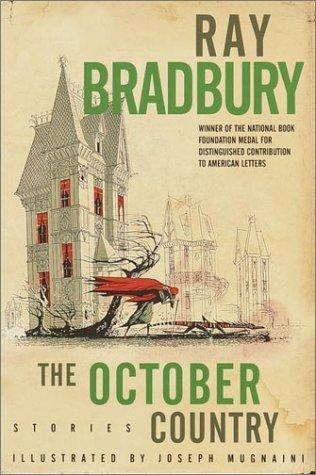
I remember it so well. I sat down on the sofa, opened the front cover, gorgeously illustrated by Joseph Mugnaini, and found a half-page blurb titled “The Grim Reaper” (which I later learned is an excerpt from “The Scythe”). I read it, realized I was holding my breath, let it out, read it again, and closed the book. I looked up at my husband and said, “I have a feeling this is going to be one of those books that changes my life.”

I was right.

If you haven’t read The October Country, I strongly recommend you do. My personal favorites from it are “Skeleton,” “The Lake,” “The Emissary,” “Jack-in-the-Box,” and of course, “The Scythe.” The first thing I did after finishing this book was write “Jack and the Bad Man,” my own personal homage to Bradbury — and also the first short story I ever had published. The next thing I did was get my hands on Something Wicked This Way Comes. The good thing about starting so late? I have a whole lot of Bradbury left to discover.

Recently I heard about this new tribute anthology coming out, Shadow Show. It includes stories by authors such as Neil Gaiman, Margaret Atwood, and Bradbury himself. Plus, it’s co-edited by HWA member Mort Castle, who did a fantastic job editing On Writing Horror – a must-read book on craft for horror writers. I’ve already pre-ordered my copy of Shadow Show, and I can’t wait for it to come out.

Which brings me back to my honesty: I feel sad that I’m too new a writer to be included in something like this, paying tribute to a man I never had the honor of knowing but who touched my life nonetheless. When I go back and read the foreword written by Bradbury in my edition of The October Country, I get chills. It’s called “May I Die Before My Voices.” It begins with this:

Now, what in blazes does the above title mean? It means that voices have been talking to me on early morns since I was about twenty-two or twenty-three. I call them my Theater of Morning Voices, and I lie quietly and let them speak in the echochamber between my ears. At a certain moment when the voices are raised high in argument or passionate declaration or are like rapiers’ ends, I jump up (slowly) and get to my typewriter before the echoes die. By noon I have finished another story, or poem, or an act of a play, or a new chapter for a novel.

Reading these words brings me such solace, because I, too, let voices speak in the echochamber of my mind, and I, too, take down their mysterious ideas. Even a Great like Bradbury, who the contemporary authors I look up to looked up to, started when he was in his early twenties, like I did, and was driven by inspiration and passion.

Reading his stories takes me elsewhere; I leave behind the doubts and drive, the loneliness and impatience, the platform-building and networking, my own age and gender, and I am absorbed into a world of creativity so unbridled and personal it feels not like discovering something new but like finding something I’ve always had inside me. When I read Bradbury, I don’t feel inadequate or left out; I feel like I’m home. I feel like he was a kindred spirit I never got to meet.

His foreword ends with this:

My voices are still speaking, and I am still listening and taking their wild advice. If some morning in the future I wake and there is silence, I’ll know my life is over. With luck, on my last day, the voices will still be busy and I will still be happy.

April 24, 1996

From everything I’ve heard, Mr. Bradbury got his wish. May he rest in peace. He will always hold a place in my heart.

Posted in Authors | Tagged , , , | 31 Comments

Writing Terms & Editing Symbols

Hi guys!

Today I’m talking contentious writers’ terminology over at Patrick Ross’s blog The Artist’s Road. I’d love for you to visit me there to read “What the Heck Should I Call Myself, Anyway?

Also, I’ve just added a new document free for download at The Organized Writer: an Editing Symbols Chart. So definitely check that out as well!

Thanks, and wishing you all a great week,

Annie

Posted in Resources | Tagged | Leave a comment

10 Tips for Attending a Writers’ Conference

This weekend I attended the DFW Writers’ Conference. It was my second year, and this time I got some things right (that I learned last year) and some things wrong (that I experimented with this year). So I thought I’d share with you all some of my newfound tips, so that you can be more prepared at the next con you attend. And I totally recommend DFWcon, by the way. Great stuff.

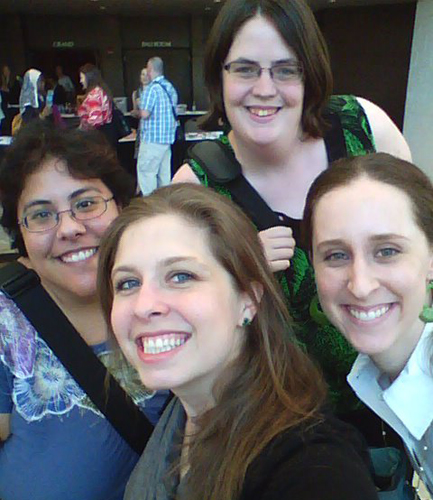
Clockwise from the top: Addley Fannin, me, Kelsey Macke, and Febe Moss.

Without further ado, the top 10 things I learned:

1. Set your goals ahead of time. Choose 1-2 big ones and prioritize.

2. The first thing you should do is pick up your nametag, write your Twitter handle under your name, and put it on. I wish I could claim this idea as my own, but I totally snagged it from networking queen Kelsey Macke.

3. Be on Twitter. This is one I didn’t do, and I regret not doing it. I don’t have a smart phone (which, quite honestly, I greatly value for the rest of the year), so I definitely felt like I was missing out on all the #DFWcon hashtag conversations. Maybe next year I’ll borrow one or something.

4. Make yourself recognizable in person and online. This includes 1) Don’t forget your nametag when you change outfits that night or the next day. 2) Follow tip #2 above. 3) Make your actual name your Twitter handle. And 4) Make your Twitter picture look like you ahead of time, so we can make the name/face/Twitter connection.

5. Don’t be afraid to take risks. Sometimes they work; sometimes they don’t. You won’t know until you try.

6. Go with positive people who share similar goals. Like my all-time favorite wingwoman Febe Moss.

7. Find new friends (like the awesome Christine Arnold), and meet up with them more than once to reinforce the connection.

8. Follow up online with connections you made. Find them on Twitter, say hi, and give them a follow.

9. Now, some people will disagree with this. But I say don’t make it your goal to pitch to agents in social situations. Be ready, but don’t pitch unless they invite you to. Accepting that some interactions will just be for fun takes a lot of the pressure off and made my time a lot more enjoyable. Plus, just because you don’t pitch at the con doesn’t mean you can’t query them later and remind them how you met.

10. Leave classes that don’t do it for you. You’ve paid too much money to waste an hour in a class that isn’t what you need.

Those are the things I learned this year! Have you been to a writers’ conference before? Do you have any other tips to add?

Posted in Advice for Writers | Tagged , | 27 Comments

What Is Literary Fiction?

And why you should stop assuming you hate it.

Photo by shutterhacks.

  • Myth: Anything you read in school is literary fiction.
  • Myth: “Intellectual” works are automatically literary fiction.
  • Myth: Literary fiction is always boring/has no plot.
  • Myth: Literary fiction is always wordy.
  • Myth: Literary fiction is snobby.
  • Myth: Literary fiction is “better” than commercial fiction.

As you can see, there are a lot of misconceptions about literary fiction. And when you ask someone what literary fiction actually is–really try to pin down a definition–the answers get pretty vague. Even industry experts seem to disagree on what the requirements are for a piece of fiction to be called “literary.” What does it even mean? Isn’t all literature “literary”? Help!

I hear a lot of people slam literary fiction on a semi-regular basis, usually based on one of the myths above rather than a genuine knowledge of what it is. And as someone who is absolutely passionate about both reading and writing literary fiction, that makes me sad. Especially since, more often than not, there’s only one type of literary fiction that someone doesn’t enjoy.

*does Scooby Doo double-take grunt*

That’s right. I’m here with a theory.

Part of the reason there’s so much confusion and misunderstanding around literary fiction is that what we mean when we say “literary fiction” is actually three separate things: a style of writing, a genre of book, and a qualifier.

So I’m going to go through each type in hopes of clearing up some of the confusion and possibly nailing down exactly what you might not like about certain types of literary fiction.

1) Style

Sentence structure, vocabulary, metaphors, similes, and a generally “poetic” (or “stark”) quality.

Any genre in the world can be written in a literary style. There are two drastically opposite styles that most people identify as literary:

The Rambler– Those long, complex, lovely, and sometimes convoluted sentences that often seem to be more focused on the beauty of the language above the message they tell. If you can’t stand Herman Mellville’s Moby Dick or Mary Shelley’s Frankenstein, you probably dislike verbose prose (which usually also means you won’t enjoy many things written before 1900.)

The So Tight It’s Cryptic– When an author makes nouns and adjectives into verbs for the sake of compact sentences, things can get confusing. If reading Ray Bradbury’s Something Wicked This Way Comes or Don DeLillo’s The Names felt more like work than pleasure to you, you might not like your prose packed so tightly.

2) Genre

Established plot and character expectations just like any other genre (romance, mystery, horror, etc.).

In romance, it’s expected that there will be two characters in conflict who eventually get together. In mystery, it’s expected that a main character will be faced with a mysterious event he or she then has to uncover the explanation for. And in horror, the reader knows that there will be some version of a “monster” that the main character will have to beat to survive. Literary fiction, as a genre, also has certain expectations it must fulfill.

The Nothing Happens Plot– With the popularity of thrillers, apocalypse stories, and action-packed adventures, small-scale stories can seem plotless. The truth is that every story has a plot, but what people mean when they say a book “has no plot” is that the plot is mundane. The characters live slow, ordinary lives, often stuck in a rut, and no global safety is at stake. Stories of broken relationships, general discontent, and “I’m at the end of my life” stories often seem light on plot. If you couldn’t have been more bored by F. Scott Fitzgerald’s The Great Gatsby or John Knowles’s A Separate Peace, the genre type of literary fiction might not be for you.

The Intentionally Unlikable Characters– Most commercial genres strive to make at least their main characters likable, relatable, and memorable. But Vladimir Nabokov’s Lolita turns that tradition on its head with an unabashed child molester. And the most important part of that? Nabokov never intended for the reader to fall in love with Humbert Humbert (or Lolita, for that matter). But if adoring your main character is a must–books like Lolita and Philip Roth’s Goodbye, Columbus are absolutely intolerable to you–you’re less likely to find something in the literary genre that suits your taste.

3) Qualifier

Poses a larger question and answers it using methods other than plot and character.

Now this is where things get prickly… and where people get snobby. “Qualifier” inherently implies quality. So does that mean that all quality books are literary fiction? No. It really doesn’t. You can absolutely have commercial fiction of extraordinary quality. So if you think of literary fiction as snobby, please reconsider. And if you’re perpetuating that myth, please stop.

So what do I mean by qualifier? Quite simply, this type of literary fiction aims to answer “large” questions (such as difficult issues about morality, life, death, love, human nature, etc.) through devices other than character and plot. In other words, a character waxing poetic about betrayal doesn’t make a work this type of literary. But a literary device that aims to force the reader to come to their own conclusions about betrayal is.

It is such literary devices (and admittedly “buried” messages) that most often frustrate readers. And let’s be honest here: it is this type of literary that most draws the hyper-intellectual snoots who tend to give literary fiction a bad name among commercial fiction fans. Some authors revel in reaching only a very select readership. If you’re not that readership… just ignore those authors.

So if you’re reading a book that has an unusual or strange literary device in it (such as an unreliable narrator, a story told out of order, switching points of view, story within a story, satire, metafiction, and epistolary novels), there’s a good chance that device was chosen to make you think. The author is trying to tell you something more about the story through this unusual device.

The Unchronological Story– If a novel is told infuriatingly out of order, such as Emily Bronte’s Wuthering Heights or Penelope Lively’s Moon Tiger, there’s a good chance that was done for a reason. Is the author asking you a deep question about time, for example? If you don’t much care for drawing your own conclusions, this type of literary fiction probably won’t be your cup of tea.

The Strange Point(s) of View– In The Book Thief by Markus Zusak, Death (as in the Grim Reaper) is the narrator. In good literary fiction, this type of strange point of view is only done for a reason. In Zusak’s case, he’s trying to tell you something about his world, characters, or message that a different narrator couldn’t have told you. Similarly, William Faulkner’s As I Lay Dying switches point of view between most of the characters. If you don’t enjoy puzzling out why these types of devices are used, you might avoid “qualifier” literary fiction.

The Takeaway

As you can see, it’s easy to have a literary book that is just one or two of these things, which means that if you don’t like one aspect, you shouldn’t necessarily discount all literary fiction.

If you dislike literary genre plots, for example, you could try “upmarket” fiction, which generally means commercial plot written in a literary style and with deeper messages (i.e. A book with an easy plot and likable characters that you can delve into if you want–but don’t have to in order to understand what’s happening, like Anne Rice’s Interview with the Vampire). Or if you dislike literary style writing, you could try Jandy Nelson’s The Sky is Everywhere, which has a literary plot and deeper themes, but is relatively straight-forward in style. And PS- If you love all three, I recently enjoyed Matt Bondurant’s The Night Swimmer.

My point is: now that you are aware that people mean three different things when they call something “literary,” you can figure out which types you don’t care for and avoid those–without automatically discounting all literary fiction.


So how about you? Do you like literary fiction? Loath it? Which type is your favorite, and which makes you want to throw a book against the wall?

Like this post? Check out all posts in the What is Genre? series!

Posted in Genres | Tagged , | 65 Comments

Sonnet Building Step 5: “Final Dress”

[If sonnets just aren’t your cup of tea, check out the related prose discussion below.]

Critique

Sonneteers! At this point, you’ve done everything you can on your own to make your sonnet shine. The next step, if you’re up to it, is getting outside feedback. Now if you’re like me, you have a poetry critique group to turn to. But I’ve found that to be pretty rare. So… I’m offering to be your critique group.

IF you want feedback, I will give it to you. If you’re really brave, you can post your sonnet in the comments and see what all of the sonneteers have to offer. If you’re a little more hesitant than that, you can email me privately at annie_07@alumni.utexas.net.

Scared? Worried that I’ll tear you apart? Well, I’m not that type of critiquer. And the best way to assure that you get only what you need is to ask. When you email me your poem, preface it with what you want. “This is my first sonnet, and I’m not concerned about meter so much as the overall concept. Does the story come across to you?” Or “I want to submit this to a sonnet contest but my meter isn’t perfect. Can you help me smooth it out?” Etc. I’m not going to give you feedback that you aren’t ready for.

And if you want to share your poem with me without asking for critique, I’d love that! I absolutely want to read your sonnets, whenever you finish them, and I completely understand if you don’t want critique! I understand that everyone is at their own level, and I’m not going to judge you in a negative way. I promise. =)

If you didn’t finish your sonnet, I’d love to hear why. You can be completely honest with me. And if you have suggestions or things I might think about if I ever teach this material again, please let me know.

For those of you wondering what’s involved in poetry critique, here are some of the things I hear a lot:

  • word choice (if a word or phrase gives the wrong tone)
  • meter
  • rhyme
  • title choice
  • factual accuracy
  • clarity of meaning
  • overall flow and rhythm
  • message of poem

React

So what do you do once you’ve received your critique? You absorb, evaluate, and implement.

There’s no reason to be afraid of feedback. It’s just someone else’s opinion. You are still the writer. If they say “this sounds bad,” and you disagree, you don’t have to change it. It’s your creative project, remember? Consider, decide, and act. No good critiquer is going to be insulted if you don’t agree with what they say.

Share

Not everyone shares my goals of publication. That’s perfectly fine. But I will admit that if you’ve spent so much effort on a poem… I can’t understand why you wouldn’t want to share it with someone. Whether it be me, your spouse, your cat, or at a local open mic night, I encourage you to show it to someone you trust.

And if you’re really brave, submit it for publication! I have tips on how to get started with that both here and here. Also, mention this to me in your email and I might be able to recommend a venue to you.

Posts in the Sonnet Building series:

Step 1: “Gathering DNA”

Step 2: “Structuring a Skeleton”

Step 3: “Filling out the Flesh”

Step 4: “Muscle Sculpting”

Step 5: “Final Dress”

* * *

Prosers: How do you decide when to listen to critique feedback, and when to let it wash over you? Have you ever had an experience that made you question your own judgment?

Sonneteers: Thanks so much for joining me! Writing a sonnet is no easy feat, and I really admire your courage in giving it a try. Hopefully it was a positive experience for you, even if you didn’t come out with quite what you expected. I wish you the best of luck in your future poetry endeavors.

In case you’ve missed it, here’s the whole series:

Intro to Sonnet Building 101
Sonnet Building Step 1: “Gathering DNA”
Sonnet Building Step 2: “Structuring a Skeleton”
Sonnet Building Step 3: “Filling out the Flesh”
Sonnet Building Step 4: “Muscle Sculpting”
Sonnet Building Step 5: “Final Dress” (above)

I hope you’ve all had a great National Poetry Month!

Posted in Advice for Poets | Tagged , | 6 Comments